Large 4WD
Defender vs LandCruiser 300
Land Rover · Toyota
Head to head
Patrol
LandCruiser 300
Last updated September 2026
From$105,408
From$107,394
The Toyota LandCruiser 300 is the better long-distance buy: its V6 diesel claims 8.9L/100km to the Nissan Patrol V8's 14.4, it carries ANCAP's five stars where the Patrol has none, and its resale stays near what you paid. The Nissan Patrol is the choice for V8 character and space: 298kW, up to eight seats and a lower entry price.
5.5L
The Nissan Patrol's V8 claims 14.4 litres per 100km; the LandCruiser 300's diesel claims 8.9. Nissan's 140-litre tank blunts the sting, but the servo sees you more often.
Pick a priority — we’ll show the numbers that matter and tell you which car we’d choose.
| Nissan Patrol | vsspecification | Toyota LandCruiser 300 |
|---|---|---|
298 kW (leads) | Power | 227 kW |
560 Nm | Torque | 700 Nm (leads) |
3,500 kg | Braked towing | 3,500 kg |
14.4 L/100km | Fuel economy | 8.9 L/100km (leads) |
Based on Essentials, we’d pick the Toyota LandCruiser 300.
| Nissan Patrol | vsspecification | Toyota LandCruiser 300 |
|---|---|---|
273 mm (leads) | Ground clearance | 245 mm |
34.4° (leads) | Approach | 31° |
26.3° (leads) | Departure | 25° |
A genuine draw, decided by what you value. The Patrol brings more ground clearance at 273mm, a better 34.4-degree approach angle, and a hydraulic-body ride reviewers rate highly over rough ground. The LandCruiser counters with front and rear diff locks, a deeper suite of traction electronics, and the touring reliability that has made it the default for remote travel. Raw geometry goes to the Nissan, hardware and peace of mind to the Toyota.
A genuine tie.
Both cars handle off-roadequally well — this one’s a draw.
| Nissan Patrol | vsspecification | Toyota LandCruiser 300 |
|---|---|---|
3,500 kg | Braked towing | 3,500 kg |
3,500 kg (leads) | GVM | 3,280 kg |
Both are rated to 3500kg braked with a 350kg tow ball, so the headline is a tie. The diesel LandCruiser is the easier long-distance rig on 700Nm of low-down torque and a range that survives a van behind it. The Patrol answers with a higher 7000kg gross combination mass against the Toyota's 6750kg, so it can legally carry more in the truck while towing the same trailer. Tourers lean Toyota, heavy haulers lean Patrol.
Based on Towing & weights, we’d pick the Toyota LandCruiser 300.
| Nissan Patrol | vsspecification | Toyota LandCruiser 300 |
|---|---|---|
298 kW (leads) | Power | 227 kW |
560 Nm | Torque | 700 Nm (leads) |
14.4 L/100km | Fuel economy | 8.9 L/100km (leads) |
The Patrol's 5.6-litre naturally aspirated V8 makes 298kW against the diesel's 227kW, and the road tests single out its smoothness and character as the reason buyers are chasing the run-out. The LandCruiser trades outright power for 700Nm of low-down torque from its twin-turbo V6, which is the more effective delivery for towing and low-range work. Power goes to the Nissan, usable urge to the Toyota.
Based on Engine & efficiency, we’d pick the Nissan Patrol.
| Nissan Patrol | vsspecification | Toyota LandCruiser 300 |
|---|---|---|
14.4 L/100km | Fuel economy | 8.9 L/100km (leads) |
10,000 km | Service interval | 10,000 km |
$600 | Capped service | $420 (leads) |
The Patrol wins the up-front argument: it undercuts the LandCruiser at the entry point and packs a V8 and eight seats as standard. The Toyota wins the long game, on far lower fuel use, cheaper scheduled servicing over five years, and resale that holds near the purchase price where the Patrol depreciates more conventionally. Which is the better value comes down almost entirely to how long you keep it.
A genuine tie.
Both cars handle running costsequally well — this one’s a draw.
| Nissan Patrol | vsspecification | Toyota LandCruiser 300 |
|---|---|---|
6 | Airbags | 10 (leads) |
Yes | AEB | Yes |
Yes | Adaptive cruise | Yes |
Yes | Blind-spot monitor | Yes |
Yes | 360° camera | Yes |
The LandCruiser 300 holds a five-star ANCAP rating from its 2022 test, with 89 per cent for adult occupant protection and 88 for child, backed by ten airbags. The current Patrol has never been crash-tested by ANCAP, so there is no independent score to weigh, and it runs eight airbags. Both carry autonomous emergency braking, lane keep assist, blind-spot monitoring and adaptive cruise control, but only the Toyota puts a verified result behind them.
Based on Safety, we’d pick the Toyota LandCruiser 300.
| Nissan Patrol | vsspecification | Toyota LandCruiser 300 |
|---|---|---|
8 (leads) | Seats | 5 |
12.3″ (leads) | Touchscreen | 8.0″ |
The Patrol seats up to eight, the Ti-L trading one seat for captain's chairs, while the LandCruiser splits five or seven by grade. The Nissan's extra width makes its third row more usable for adults, though boot space behind a full third row is tight in both. The Toyota answers with the plusher, better-equipped cabin: heated and ventilated front seats the Patrol keeps for the Ti-L. The Toyota also fits a head-up display the Patrol omits.
Based on Everyday & family, we’d pick the Nissan Patrol.
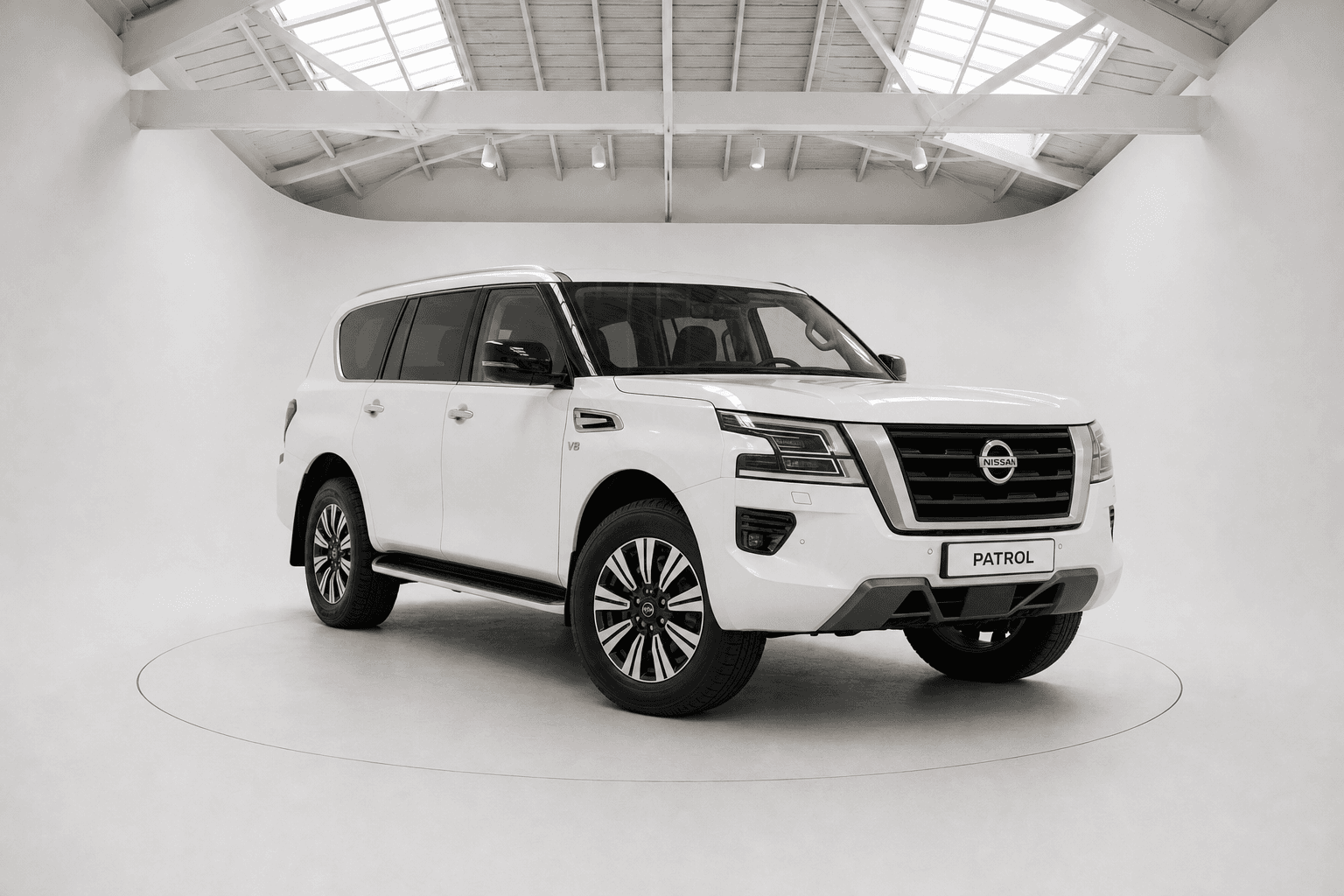
The Patrol wears its size out front: a tall, chrome-heavy grille, a wide upright bonnet line and boxy headlights that read as unmistakably big-Nissan. The MY25 update tidied the detailing without softening the mass, and the face still trades on presence rather than finesse. It is the more ornate of the two noses, and the one that looks most like a statement in a car park.
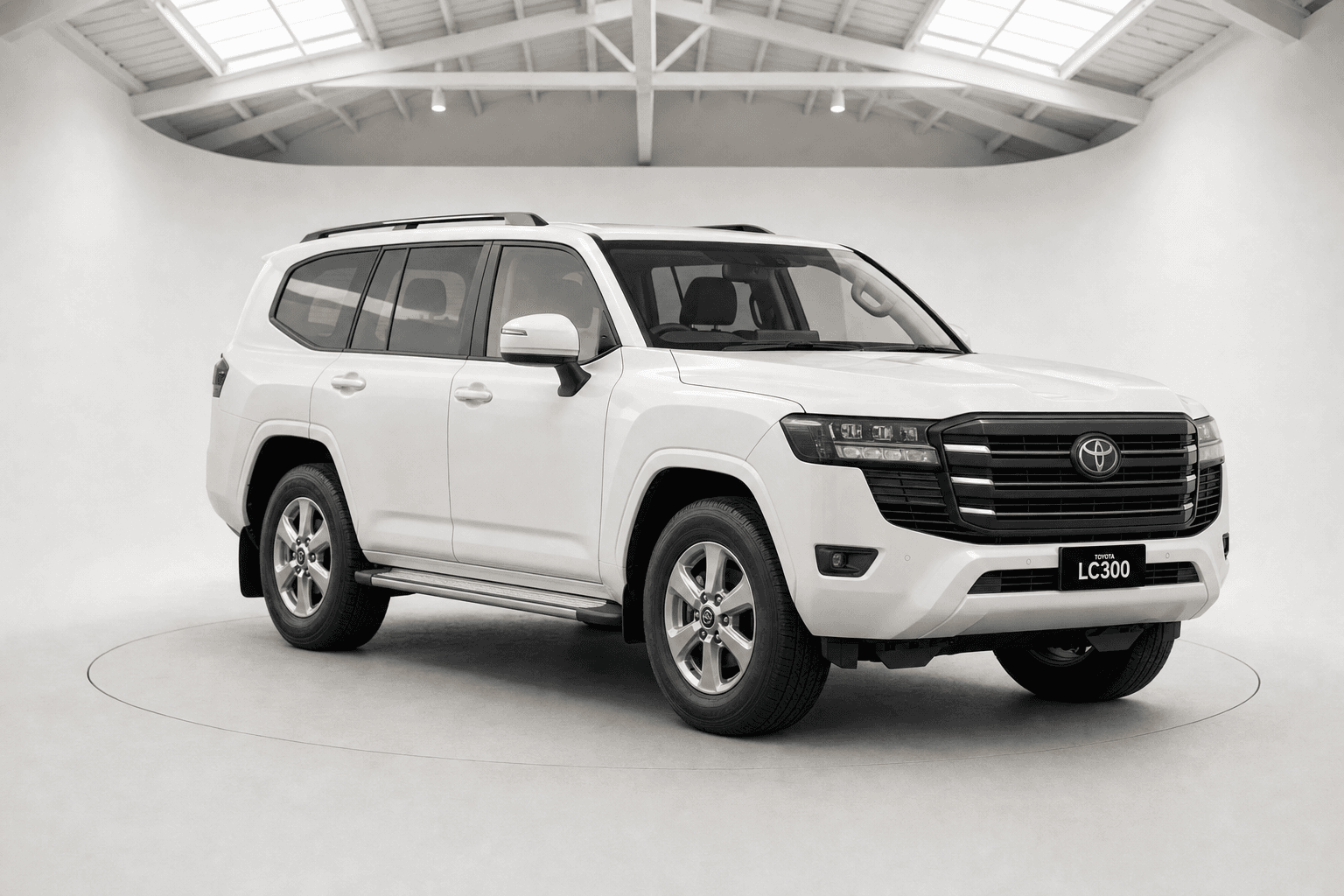
The LandCruiser 300's nose is the more restrained of the pair, all squared-off function and familiar Toyota geometry. The grille is broad but flatter, the lighting simpler, and the whole face is built to look durable rather than dramatic. It is instantly recognisable as a Cruiser, which is much of the point, and it wears the years better than a design chasing fashion would.
Images are illustrative and digitally rendered. They may not reflect the exact variant, colour or trim. Details →
Patrol
LandCruiser 300
Both are rated to tow 3,500 kg braked. Hitched at their maximums, the Nissan Patrol keeps 34 kg more payload.
3,500 kg
Braked towing3,500 kg
714 kg
Payload680 kg
364 kg
Payload at max tow330 kg
GVM
Limit that bites firstGVM
350 kg
Max ball weight350 kg
Assuming 10 per cent of the trailer weight.
Two adults plus luggage is roughly 400 kg.
Nissan Patrol Ti
Over a limit. This combination does not comply.
Tow rating
0 kg under the 3,500 kg braked rating
Vehicle GVM
Over GVM by 36 kg. Lighten the load or the ball.
Combined GCM
314 kg spare across the whole combination
Tow ball limit
0 kg under the 350 kg ball limit
Toyota LandCruiser 300 GR Sport
Over a limit. This combination does not comply.
Tow rating
0 kg under the 3,500 kg braked rating
Vehicle GVM
Over GVM by 70 kg. Lighten the load or the ball.
Combined GCM
250 kg spare across the whole combination
Tow ball limit
0 kg under the 350 kg ball limit
Manufacturer maximums; the compliance plate of your exact vehicle governs. Ball weight assumed at 10 per cent where unpublished; kerb or payload calculated where the maker omits one. Check any car against your van with the towing calculator.
The Patrol's pitch is blunt, and for now it is unique.
The LandCruiser 300 is the truck the rest of the segment is measured against, and its twin-turbo V6 diesel is the reason the old V8 is no longer missed.
By Yuri Cartland, Editor
Opinions are our own.
You want V8 character and up to eight seats for the least outlay, and your yearly kilometres are modest enough that a real-world 15-plus litres per 100km will not dominate the budget. Owning the last naturally aspirated V8 4WD before it is legislated out genuinely appeals, and you would rather spend on the engine than on the crash sheet or the resale ledger.
Explore the PatrolYou cover long distances, tow regularly, or plan to keep the truck for years rather than trade it soon. The diesel's 8.9L/100km economy and touring range, the five-star ANCAP result, and resale that holds near the purchase price all reward high-kilometre, long-term ownership, and you are willing to pay more up front and service it every six months to get them.
Explore the LandCruiser 300