7-seat 4WD
Everest vs MU-X
Ford · Isuzu
Head to head
Everest
Tank 500
Last updated September 2026
From$60,000
From$75,990
The Ford Everest gets the nod for the buyer who tows: it pulls 3,500kg braked where the GWM Tank 500 stops at 3,000, carries nine airbags to six, and weighs close to 600kg less. The GWM Tank 500 is the better buy on equipment: a 255kW hybrid, a 14.6-inch screen, seven seats on hybrid grades and a seven-year warranty.
500kg
Every Ford Everest tows 3,500kg braked; the GWM Tank 500 tops out at 3,000kg. The Tank answers with 750Nm of hybrid torque and a seven-year warranty to Ford's five.
Pick a priority — we’ll show the numbers that matter and tell you which car we’d choose.
| Ford Everest | vsspecification | GWM Tank 500 |
|---|---|---|
125 kW | Power | 255 kW (leads) |
405 Nm | Torque | 648 Nm (leads) |
3,500 kg (leads) | Braked towing | 3,000 kg |
7.1 L/100km (leads) | Fuel economy | 8.5 L/100km |
A genuine tie.
Both cars handle essentialsequally well — this one’s a draw.
| Ford Everest | vsspecification | GWM Tank 500 |
|---|---|---|
229 mm (leads) | Ground clearance | 220 mm |
30.4° (leads) | Approach | 30° |
25.3° (leads) | Departure | 24° |
800 mm | Wading depth | 800 mm |
Closer than the badges suggest. Both are body-on-frame 4WDs with low range and near-identical geometry: the Everest's 30.4-degree approach to the Tank's 30, matching 800mm wading, and clearance within 10mm. The Everest adds a rear diff lock, the Tank a heavier but capable platform. Neither runs away with it; both go a long way off the bitumen.
A genuine tie.
Both cars handle off-roadequally well — this one’s a draw.
| Ford Everest | vsspecification | GWM Tank 500 |
|---|---|---|
3,500 kg (leads) | Braked towing | 3,000 kg |
855 kg (leads) | Payload | 790 kg |
3,100 kg | GVM | 3,395 kg (leads) |
The Everest's category. It tows 3500kg braked, the outback benchmark, where the Tank 500 stops at 3000kg, a 500kg gap that decides legality near the limit for a big caravan. The Everest also carries a little more payload. The Tank 500 tows a serious trailer with power to spare, but for towing near the maximum the Ford is the tool.
Based on Towing & weights, we’d pick the Ford Everest.
| Ford Everest | vsspecification | GWM Tank 500 |
|---|---|---|
125 kW | Power | 255 kW (leads) |
405 Nm | Torque | 648 Nm (leads) |
7.1 L/100km (leads) | Fuel economy | 8.5 L/100km |
The Tank 500 dominates outputs. Its petrol-hybrid makes 255kW and 648Nm and the plug-in 300kW and 750Nm, well clear of the Everest's 125kW 2.0-litre and 184kW 3.0-litre V6 diesel. That translates to markedly stronger acceleration. The Everest's V6 is torquey and proven and better suited to towing than sprinting, but for outright power the Tank 500 wins comfortably.
Based on Engine & efficiency, we’d pick the GWM Tank 500.
| Ford Everest | vsspecification | GWM Tank 500 |
|---|---|---|
7.1 L/100km (leads) | Fuel economy | 8.5 L/100km |
The Tank 500's pitch. It opens near $70,000 to the Everest's $60,000 but answers the gap with far more kit, a 255kW hybrid, a 14.6-inch screen, heated and ventilated seats and a seven-year warranty. The Everest's value is its lower entry, proven reliability and stronger resale, not its features list. For kit-per-dollar the Tank 500 leads; for holding its value the Everest.
Based on Running costs, we’d pick the GWM Tank 500.
| Ford Everest | vsspecification | GWM Tank 500 |
|---|---|---|
5★ | ANCAP | 5★ |
86% (leads) | Adult occupant | 85% |
86% (leads) | Safety assist | 74% |
9 (leads) | Airbags | 6 |
Yes | AEB | Yes |
Yes | Adaptive cruise | Yes |
Yes | Blind-spot monitor | Yes |
Yes | 360° camera | Yes |
A split call, but the Everest edges it. Both hold a five-star ANCAP rating; the Everest carries nine airbags to the Tank 500's six and scored higher for adult occupant protection, while the Tank's rating is the fresher 2024 result with a higher vulnerable road user score. Both run the expected driver aids. On airbag count and pedigree, the Ford leads.
Based on Safety, we’d pick the Ford Everest.
| Ford Everest | vsspecification | GWM Tank 500 |
|---|---|---|
5 | Seats | 7 (leads) |
898 L (leads) | Boot | 795 L |
12.0″ | Touchscreen | 14.6″ (leads) |
A genuine draw. Both are seven-seat body-on-frame family 4WDs, splitting five or seven seats by grade. The Tank 500 brings the better-equipped cabin; the Everest brings the lighter body, the extra airbags and the stronger tow rating. Kit and warranty to the GWM, proven family credentials to the Ford. The choice splits on priorities, not on any clear winner.
A genuine tie.
Both cars handle everyday & familyequally well — this one’s a draw.
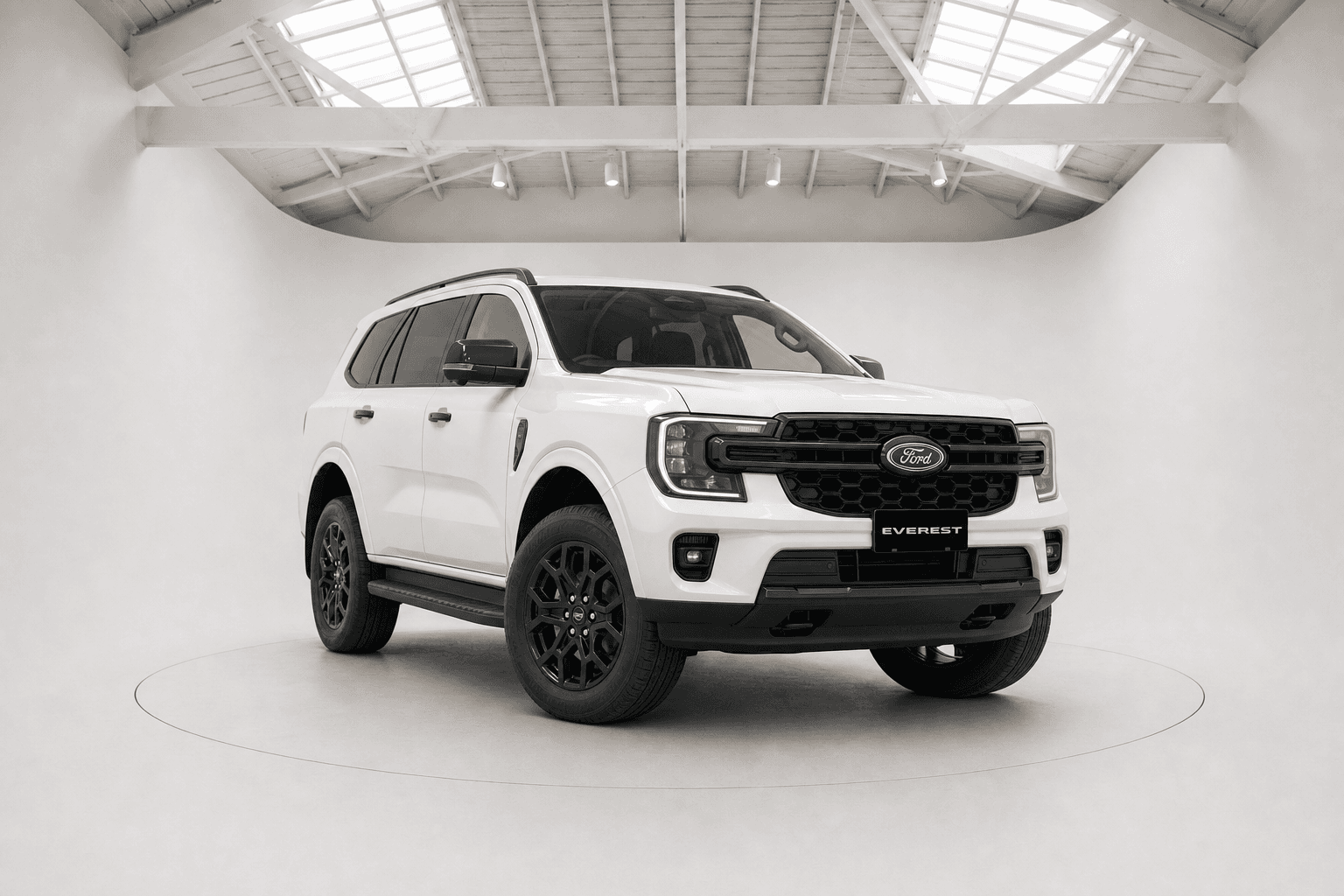
The Everest wears a bold, blocky face with a broad grille and C-clamp LED headlights that read as modern and purposeful. Higher grades add darker detailing and bigger wheels, but even the Active looks like a serious family 4WD rather than a soft SUV. It is styled to signal capability and Ford's ute-derived toughness, which is exactly the brief for a family-first buyer.
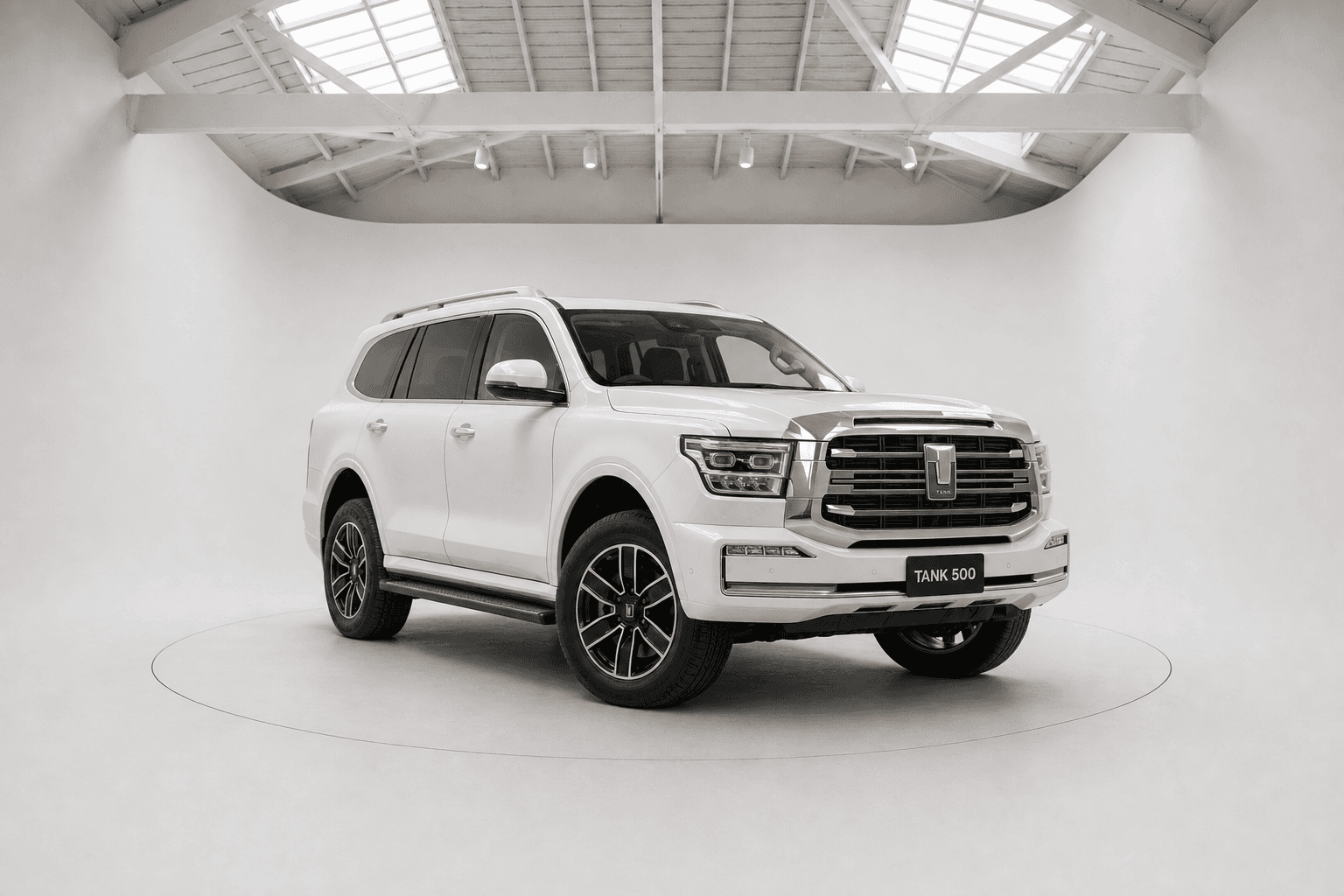
The Tank 500's face is deliberately imposing, a tall upright grille and squared LED lamps that ape the big, expensive American SUVs it undercuts. It is the showier of the two by some way, styled to read as a lot of truck for the money. Next to the Everest's purposeful blockiness, the GWM is all presence and brightwork, and it draws eyes for the money.
Images are illustrative and digitally rendered. They may not reflect the exact variant, colour or trim. Details →
Everest
Tank 500
The Ford Everest tows 500 kg more than the GWM Tank 500. Hitched at their maximums, the Ford Everest keeps 195 kg more payload.
3,500 kg
Braked towing3,000 kg
855 kg
Payload610 kg
505 kg
Payload at max tow310 kg
GVM
Limit that bites firstGVM
350 kg
Max ball weight300 kg
Assuming 10 per cent of the trailer weight.
Two adults plus luggage is roughly 400 kg.
Ford Everest Active 2.0L Turbo Diesel AWD
Fits within every published limit.
Tow rating
500 kg under the 3,500 kg braked rating
Vehicle GVM
155 kg spare after the ball weight and your load
Combined GCM
605 kg spare across the whole combination
Tow ball limit
50 kg under the 350 kg ball limit
GWM Tank 500 Ultra
Over a limit. This combination does not comply.
Tow rating
0 kg under the 3,000 kg braked rating
Vehicle GVM
Over GVM by 90 kg. Lighten the load or the ball.
Combined GCM
210 kg spare across the whole combination
Tow ball limit
0 kg under the 300 kg ball limit
Manufacturer maximums; the compliance plate of your exact vehicle governs. Ball weight assumed at 10 per cent where unpublished; kerb or payload calculated where the maker omits one. Check any car against your van with the towing calculator.
The Everest is the proven benchmark this class is measured against, and it earns that on the fundamentals.
The Tank 500 is the value challenger, and it throws a lot of metal and standard kit at the establishment for the money.
By Yuri Cartland, Editor
Opinions are our own.
Towing to 3500kg, the extra safety and a proven badge matter more to you than outright power or the longest warranty. You tow a big caravan near the limit, you want the nine airbags, the lighter body and Ford's dealer and resale strength, and you are happy with diesel power and a slightly smaller screen to have the segment's established benchmark rather than the newcomer.
Explore the EverestPower, standard equipment, a long warranty and value matter more to you than a proven badge or maximum towing. You want the 255kW hybrid or 300kW plug-in, the bigger 14.6-inch screen, the heated and ventilated seats and the seven-year warranty, all from about $70,000, and you are comfortable being an early adopter of a GWM that tows 3000kg rather than 3500.
Explore the Tank 500