Mid-size 4WD
Everest vs Prado
Ford · Toyota
Head to head
Everest
MU-X
Last updated September 2026
From$60,000
From$49,900
If the budget stretches, the Ford Everest is the one to buy: a 184kW V6 diesel the Isuzu MU-X cannot answer, a 12-inch screen to the Isuzu's 8-inch, and cheaper servicing over five years. The Isuzu MU-X is the better buy on price: seven seats on every grade, 3,500kg of towing, a six-year warranty and seven years of roadside.
6.4L
Base for base, the Isuzu MU-X's 2.2-litre diesel claims 6.4 litres per 100km against the Ford Everest's 7.1, and both still tow the full 3,500kg braked.
Pick a priority — we’ll show the numbers that matter and tell you which car we’d choose.
| Ford Everest | vsspecification | Isuzu MU-X |
|---|---|---|
125 kW (leads) | Power | 120 kW |
405 Nm (leads) | Torque | 400 Nm |
3,500 kg | Braked towing | 3,500 kg |
7.1 L/100km | Fuel economy | 6.4 L/100km (leads) |
Based on Essentials, we’d pick the Ford Everest.
| Ford Everest | vsspecification | Isuzu MU-X |
|---|---|---|
229 mm | Ground clearance | 230 mm (leads) |
30.4° (leads) | Approach | 23.4° |
25.3° | Departure | 27.6° (leads) |
800 mm | Wading depth | 800 mm |
A close draw. The Everest brings the better approach angle at 30.4 degrees, a rear diff lock, terrain modes and a purpose-built Tremor grade for the hard stuff. The MU-X counters with a better departure angle, part-time dual-range 4x4 and a rear diff lock, and reviewers rate it properly capable for the class. Clearance is level near 230mm, so the Ford edges the extremes and the Isuzu covers most tracks for less.
A genuine tie.
Both cars handle off-roadequally well — this one’s a draw.
| Ford Everest | vsspecification | Isuzu MU-X |
|---|---|---|
3,500 kg | Braked towing | 3,500 kg |
855 kg (leads) | Payload | 705 kg |
3,100 kg (leads) | GVM | 2,700 kg |
Both tow 3500kg braked on a 350kg tow ball. The Everest has more to work with for heavy loads, 600Nm from the V6 to the MU-X's 450, a 6250kg combined mass to 5900kg, and 855kg of payload to 715kg. That lets the Ford carry more people and gear while towing the same trailer. The lighter MU-X still pulls a caravan and sips a little less fuel doing daily miles.
Based on Towing & weights, we’d pick the Ford Everest.
| Ford Everest | vsspecification | Isuzu MU-X |
|---|---|---|
125 kW (leads) | Power | 120 kW |
405 Nm (leads) | Torque | 400 Nm |
7.1 L/100km | Fuel economy | 6.4 L/100km (leads) |
The Everest is the only one here offered with a V6, its 3.0-litre diesel making 184kW and 600Nm against the MU-X's four-cylinder ceiling of 140kW and 450Nm. Lower down the pair are close, the Everest's 2.0 on 125kW to the MU-X's improved 2.2 on 120kW. For outright grunt and towing ease the Ford wins; for commuting either base four does the job.
Based on Engine & efficiency, we’d pick the Ford Everest.
| Ford Everest | vsspecification | Isuzu MU-X |
|---|---|---|
7.1 L/100km | Fuel economy | 6.4 L/100km (leads) |
This is the MU-X's category and it wins it. It opens below the Everest, and even adjusting for its recommended-retail pricing against the Ford's driveaway figures it is the cheaper way into a seven-seat 3500kg diesel, with a six-year warranty and standard seven-year roadside on top. The Everest claws back cheaper servicing over five years, but on the numbers that matter at purchase, the Isuzu is the value pick.
Based on Running costs, we’d pick the Isuzu MU-X.
| Ford Everest | vsspecification | Isuzu MU-X |
|---|---|---|
5★ | ANCAP | 5★ |
86% | Adult occupant | 86% |
86% (leads) | Safety assist | 84% |
9 (leads) | Airbags | 8 |
Yes | AEB | Yes |
Yes | Adaptive cruise | Yes |
Yes | Blind-spot monitor | Yes |
Yes | 360° camera | Yes |
Both hold a five-star ANCAP rating dated 2022 and valid to the end of 2028, each rated alongside its ute sibling. The Everest scores higher on the sub-tests, 93 per cent child occupant protection to 85 and 74 per cent for vulnerable road users to 69, and adds a ninth airbag. Adult protection ties at 86 per cent, and both run lane-keep and autonomous emergency braking as standard.
Based on Safety, we’d pick the Ford Everest.
| Ford Everest | vsspecification | Isuzu MU-X |
|---|---|---|
5 | Seats | 7 (leads) |
898 L (leads) | Boot | 311 L |
12.0″ (leads) | Touchscreen | 8.0″ |
A genuine split. The MU-X seats seven in every grade and undercuts on price, which is much of its family appeal, while the Everest seats seven in all but the five-seat base Active. The Everest is wider inside, more refined on the long haul and stronger on the ANCAP child-protection score. The Isuzu answers with standard seven seats, the longer warranty and a lower entry price for the same three rows.
A genuine tie.
Both cars handle everyday & familyequally well — this one’s a draw.
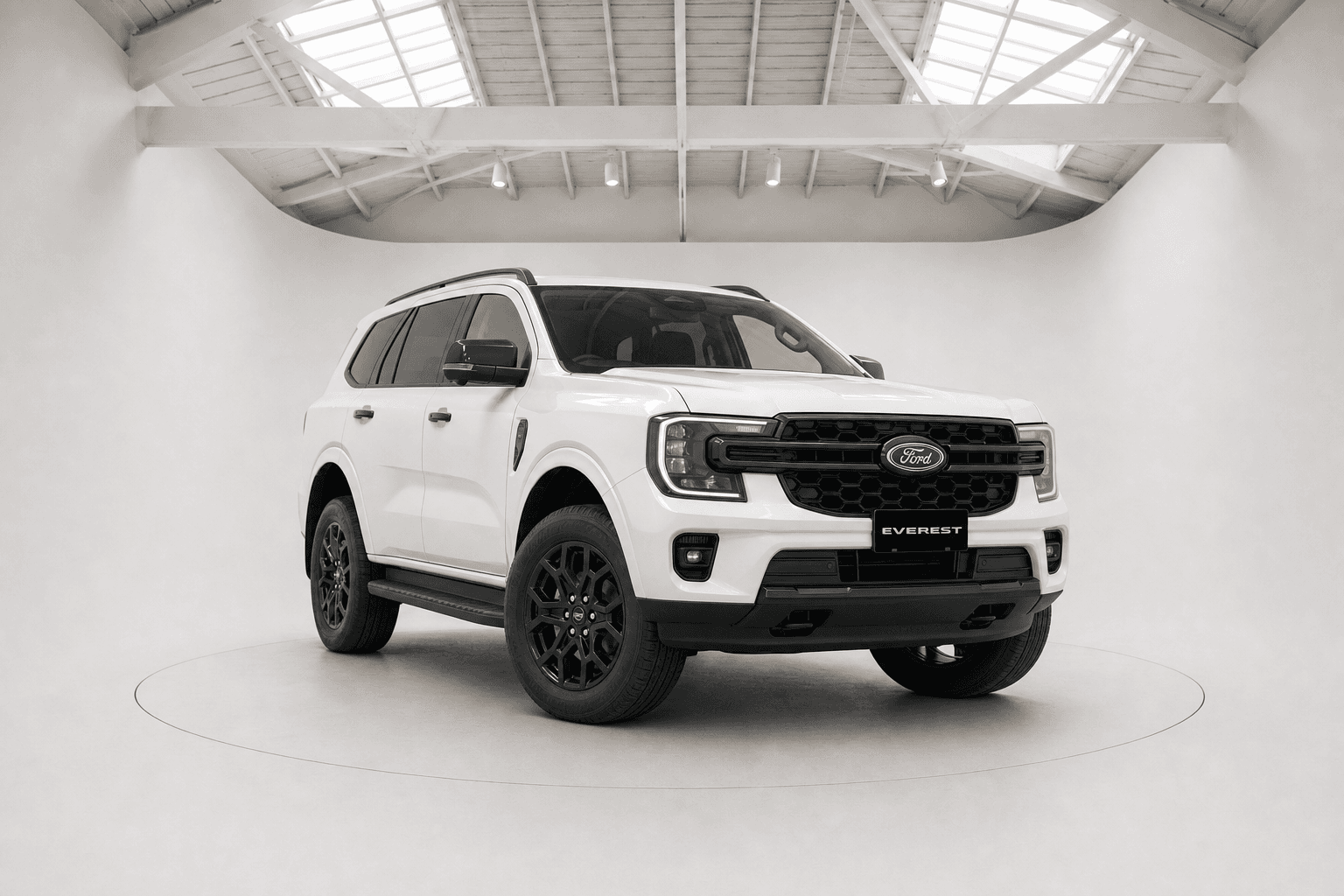
The Everest wears the widest, most modern face in this pair, a broad grille framed by C-clamp LED headlights that tie it visually to the Ranger it shares a platform with. The MY26.5 update kept the look current without reinventing it, and the result reads as the more premium, more car-like nose of the two. That matches how it drives, and it is the one that looks most at home in a school car park.
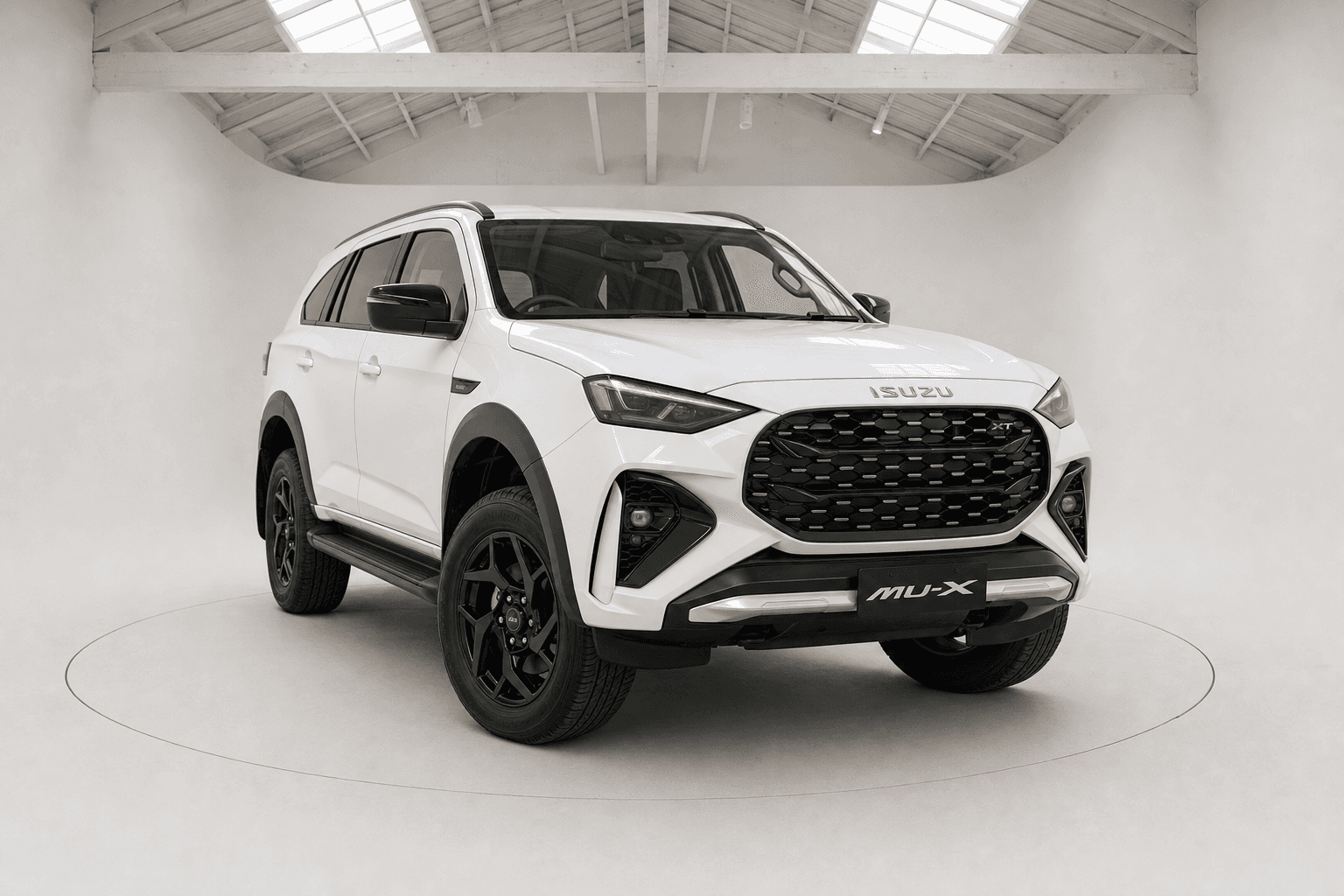
The MU-X's front is squarer and more traditional, updated in the 2025 facelift with a bolder grille and reshaped lights but still unmistakably utilitarian. It looks tougher and plainer than the Everest, function placed ahead of fashion. The face suits the value pitch, honest and hard-wearing rather than trying to out-style the newer Ford, and it is the more workmanlike of the two by some margin.
Images are illustrative and digitally rendered. They may not reflect the exact variant, colour or trim. Details →
Everest
MU-X
Both are rated to tow 3,500 kg braked. Hitched at their maximums, the Ford Everest keeps 190 kg more payload.
3,500 kg
Braked towing3,500 kg
855 kg
Payload715 kg
505 kg
Payload at max tow315 kg
GVM
Limit that bites firstGCM
350 kg
Max ball weight350 kg
Assuming 10 per cent of the trailer weight.
Two adults plus luggage is roughly 400 kg.
Ford Everest Active 2.0L Turbo Diesel AWD
Fits within every published limit.
Tow rating
0 kg under the 3,500 kg braked rating
Vehicle GVM
105 kg spare after the ball weight and your load
Combined GCM
105 kg spare across the whole combination
Tow ball limit
0 kg under the 350 kg ball limit
Isuzu MU-X LS-M 2.2L Turbo Diesel 4WD
Over a limit. This combination does not comply.
Tow rating
0 kg under the 3,500 kg braked rating
Vehicle GVM
Over GVM by 35 kg. Lighten the load or the ball.
Combined GCM
Over GCM by 85 kg. Trailer and load cannot both stay.
Tow ball limit
0 kg under the 350 kg ball limit
Manufacturer maximums; the compliance plate of your exact vehicle governs. Ball weight assumed at 10 per cent where unpublished; kerb or payload calculated where the maker omits one. Check any car against your van with the towing calculator.
The Everest is the truck the mid-size 7-seat class is measured against, and the reviews are near-unanimous on why: it drives like a car.
The MU-X's pitch is value, and it is a strong one.
By Yuri Cartland, Editor
Opinions are our own.
On-road refinement and cabin tech matter to you, you want the V6's 184kW and 600Nm or simply the option of it, and you value the ride reviewers rate best-in-class for the long family trips. You are comfortable paying more up front and stepping past the five-seat base Active, and you would rather have the cheaper servicing than the longer warranty.
Explore the EverestThe lowest price into a genuine seven-seat 3500kg-braked diesel is the priority, and the six-year warranty plus standard seven-year roadside cover matter more to you than cabin polish or outright refinement. You cover most of your kilometres under 150,000, you can live with a plainer and noisier cabin, and you would rather bank the several-thousand-dollar saving than pay for the newer Ford's on-road manners.
Explore the MU-X