Value cross-shop
Everest vs Prado
Ford · Toyota
Head to head
Defender
Prado
Last updated September 2026
From$112,617
From$79,390
The Toyota Prado is the pick on value and resale: it costs tens of thousands less than a comparable Land Rover Defender, holds the newer ANCAP result, and carries a 110-litre tank against 89. The Land Rover Defender is the choice for capability with polish: air suspension, 900mm of wading against the Prado's 700, and a stronger diesel six.
200mm
Every Land Rover Defender wades at least 900mm; every Toyota Prado is rated to 700mm. That is a full 200mm of extra river between the two badges.
Pick a priority — we’ll show the numbers that matter and tell you which car we’d choose.
| Land Rover Defender | vsspecification | Toyota Prado |
|---|---|---|
183 kW (leads) | Power | 150 kW |
570 Nm (leads) | Torque | 500 Nm |
3,500 kg | Braked towing | 3,500 kg |
8.1 L/100km | Fuel economy | 7.6 L/100km (leads) |
Based on Essentials, we’d pick the Land Rover Defender.
| Land Rover Defender | vsspecification | Toyota Prado |
|---|---|---|
295 mm (leads) | Ground clearance | 210 mm |
37.5° (leads) | Approach | 31° |
41.9° (leads) | Departure | 17° |
900 mm (leads) | Wading depth | 700 mm |
Off-road, these two reach the same place by opposite routes, and it's a close call. The Defender wins the published geometry, a 37.6-degree approach and 900mm of wading to the Prado's 32 degrees and 700mm, plus Terrain Response 2 that makes hard terrain easy, and it beat the Prado to 2026's best-off-road-SUV silverware. The Prado counters with proven hardware, a lockable centre diff, low range and crawl control on every grade, the gear remote tourers trust. The Defender's road-biased tyres are the catch. Call it a tie: the abler machine versus the more trustworthy tool.
A genuine tie.
Both cars handle off-roadequally well — this one’s a draw.
| Land Rover Defender | vsspecification | Toyota Prado |
|---|---|---|
3,500 kg | Braked towing | 3,500 kg |
2,970 kg | GVM | 3,100 kg (leads) |
The towing headline ties; the fine print divides. Diesel Defenders and every Prado pull 3,500kg braked and 750kg unbraked, and the Defender holds the higher gross combination mass on the diesel 110s, 6,700kg to 6,600, publishes a 350kg tow-ball rating, and has been named the segment's most composed tow rig in Australian testing. The exceptions all sit on the Defender's side: the plug-in hybrid and both 130 bodies drop to 3,000kg, while every Prado keeps the full rating. Call it a tie, the more composed rig against the more consistent one.
A genuine tie.
Both cars handle towing & weightsequally well — this one’s a draw.
| Land Rover Defender | vsspecification | Toyota Prado |
|---|---|---|
183 kW (leads) | Power | 150 kW |
570 Nm (leads) | Torque | 500 Nm |
8.1 L/100km | Fuel economy | 7.6 L/100km (leads) |
The engine walk decides this one before the V8s even enter it. The cross-shop diesels make more of everything: 183kW and 570Nm in the D250, 257kW and 700Nm in the D350, against the Prado's 150kW and 500Nm, and AU road tests call the Defender's inline-six the sweeter unit of the two. Above them sit the 313kW P425, the 368kW P500 and the 467kW OCTA, a span the Prado has no answer to. The Prado's 2.8 is the proven, frugal unit, but reviewers call it adequate rather than strong. The Defender takes performance.
Based on Engine & efficiency, we’d pick the Land Rover Defender.
| Land Rover Defender | vsspecification | Toyota Prado |
|---|---|---|
8.1 L/100km | Fuel economy | 7.6 L/100km (leads) |
Value depends on whether you mean cost-in or cost-over-time, and the Prado wins both readings. At July 2026 driveaway pricing it opens at $79,369, about $36,000 under the cheapest diesel Defender 110, and tops out at $109,049, just under where the Defender's range begins. Both carry five-year, unlimited-kilometre warranties, but the Prado adds capped servicing ($390 a visit, six-monthly, about $3,900 over five years) and LandCruiser resale, while the Defender's options list routinely claws back whatever the sticker saved. The Prado wins value coming and going; the Defender asks you to pay for refinement.
Based on Running costs, we’d pick the Toyota Prado.
| Land Rover Defender | vsspecification | Toyota Prado |
|---|---|---|
5★ | ANCAP | 5★ |
85% | Adult occupant | 85% |
82% | Safety assist | 82% |
6 | Airbags | 9 (leads) |
Yes | AEB | Yes |
Yes | Adaptive cruise | Yes |
Yes | Blind-spot monitor | Yes |
Yes | 360° camera | Yes |
The safety split is freshness and coverage, not stars. Both wear five-star ANCAP ratings and share AEB, lane-keep assist, adaptive cruise control and blind-spot monitoring. The Prado holds the newer 2024 result, applies it to every variant and fits nine airbags, with Toyota Safety Sense standard from the base GX. The Defender's rating dates to 2020, covers the 110 excluding the V8 petrols, leaves the 90 and 130 unrated, and expires on 31 December 2026. The Prado is the more current, more completely covered car; the Defender matches the hardware on an older, narrower test.
Based on Safety, we’d pick the Toyota Prado.
| Land Rover Defender | vsspecification | Toyota Prado |
|---|---|---|
5 | Seats | 5 |
397 L | Boot | 954 L (leads) |
13.1″ (leads) | Touchscreen | 12.3″ |
Family practicality splits cleanly. The Defender brings the bigger folded boot, an eight-seat 130 and the plusher cabin, the roomier and nicer family car of the two. The Prado brings what lowers the risk of a decade of family use: a fresher 2024 safety rating covering every variant, a lower price, proven reliability and documented servicing, plus a five-seat option that fixes its boot for buyers who don't need seven seats. Both offer seven or more seats on the right grades. The Defender is the more spacious, premium pick; the Prado is the lower-risk one.
Based on Everyday & family, we’d pick the Toyota Prado.
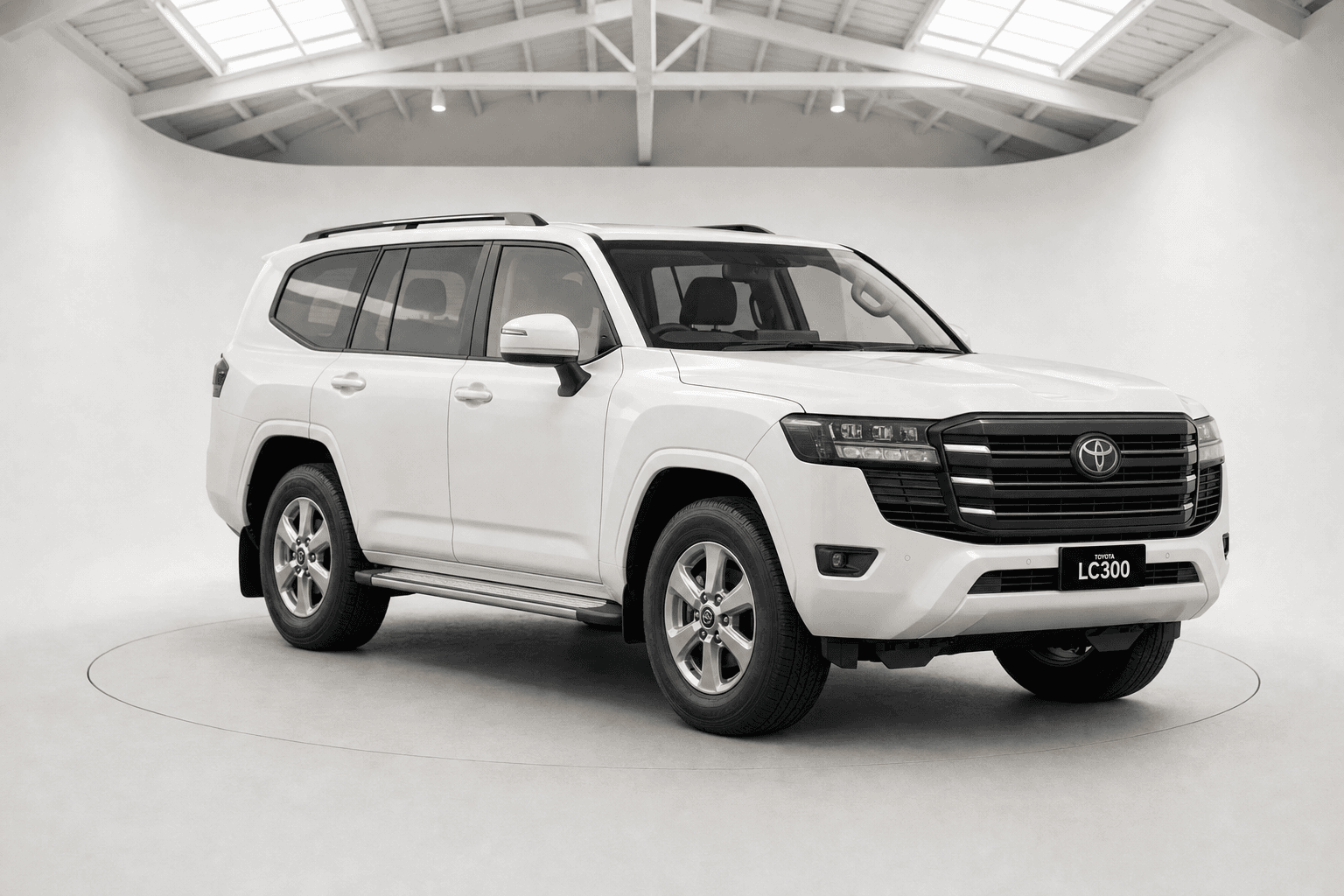
The Defender's face is modern minimalism with intent: short overhangs, round LED lamps and a clean, slab-sided nose that reads premium SUV first and 4WD second. The MY26 update added new headlights and smoked tail-lights. It looks expensive because it is.
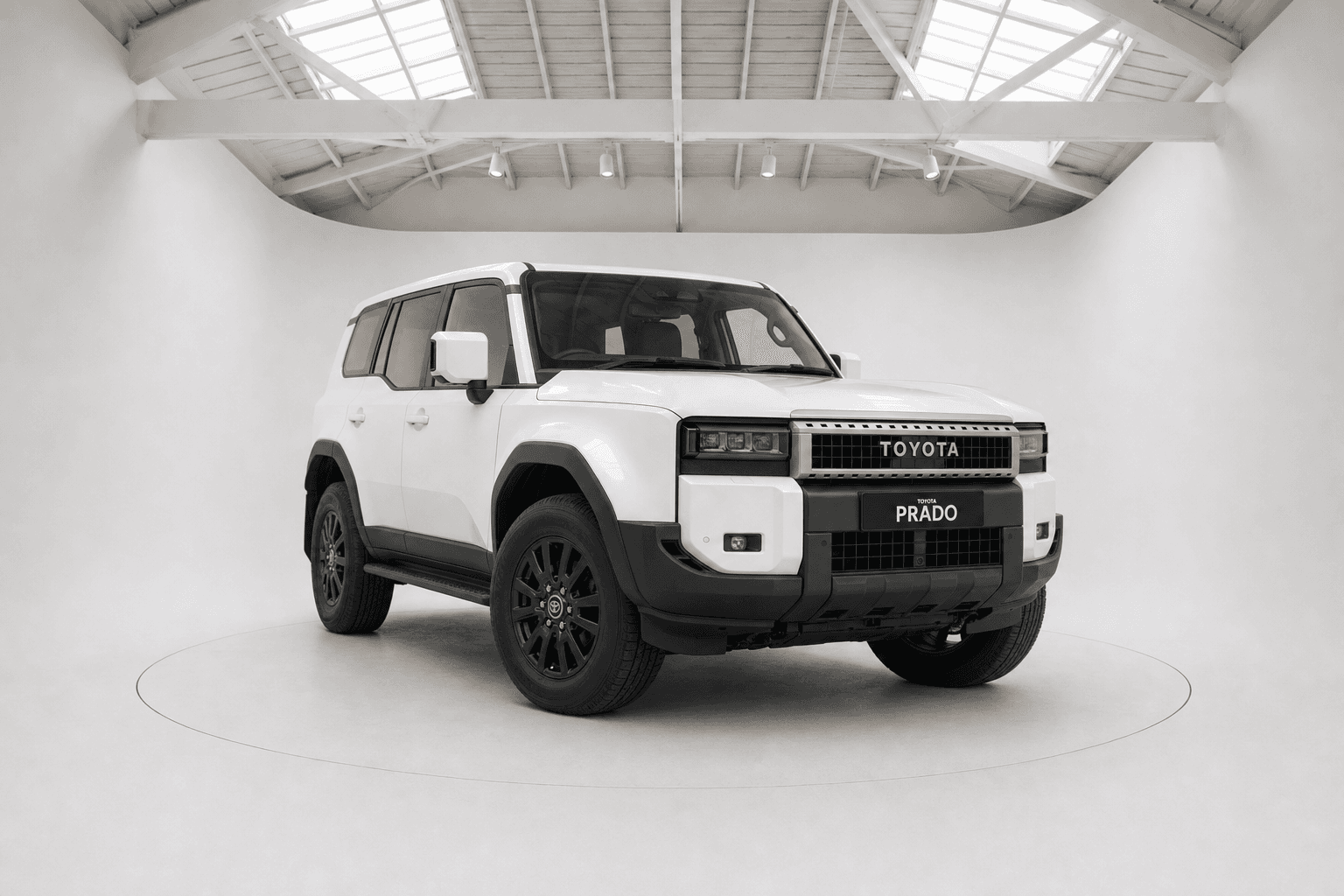
The Prado leans hard into heritage: the upright glasshouse and retro-square treatment nod to LandCruisers past, echoing the 70 Series and the original FJ40. It's the more traditional, more obviously rugged design of the two, and the badge does plenty of the talking.
Images are illustrative and digitally rendered. They may not reflect the exact variant, colour or trim. Details →
Defender
Prado
Both are rated to tow 3,500 kg braked. Hitched at their maximums, the Land Rover Defender keeps 265 kg more payload.
3,500 kg
Braked towing3,500 kg
645 kg
Payload580 kg
495 kg
Payload at max tow230 kg
GVM
Limit that bites firstGVM
150 kg
Max ball weightNot published
Assuming 10 per cent of the trailer weight.
Two adults plus luggage is roughly 400 kg.
Land Rover Defender OCTA Black
Over a limit. This combination does not comply.
Tow rating
0 kg under the 3,500 kg braked rating
Vehicle GVM
Over GVM by 105 kg. Lighten the load or the ball.
Combined GCM
245 kg spare across the whole combination
Tow ball limit
Over the 150 kg ball limit by 200 kg
Toyota Prado Altitude
Over a limit. This combination does not comply.
Tow rating
0 kg under the 3,500 kg braked rating
Vehicle GVM
Over GVM by 170 kg. Lighten the load or the ball.
Combined GCM
190 kg spare across the whole combination
Tow ball limit
No published limit. Vans usually need 8 to 12 per cent of ATM on the ball.
Manufacturer maximums; the compliance plate of your exact vehicle governs. Ball weight assumed at 10 per cent where unpublished; kerb or payload calculated where the maker omits one. Check any car against your van with the towing calculator.
The Defender answers a question the Prado never asks: what if a serious 4WD also felt like a luxury car?
The Prado does the thing LandCruisers have done for forty years: it gets you there and, more to the point, it gets you back.
By Yuri Cartland, Editor
Opinions are our own.
You want a serious 4WD that also feels like a luxury car, and you have the budget and the nerve to run it. The Defender's air-suspension ride, stronger diesel six, class-leading Pivi Pro cabin and award-winning breadth earn the premium, provided you've read the recall history and build the car you want before the options inflate it. Pick the 110 S D250 for the value entry; step to the D350 X-Dynamic SE for the engine the range is built around.
Explore the DefenderYour trips run long and remote, you keep cars for the long haul, and the maths has to work. The Prado's 110-litre tank, full-time 4WD with a lockable centre diff and low range, fresher 2024 safety and proven Toyota dependability earn their keep, and it's a clear five-figure saving to get into at the grades that line up while holding its value better. Pick the five-seat GXL for the value sweet spot; step to the Altitude for the stabiliser-disconnect hardware and all-terrain tyres.
Explore the Prado