Denza
B5
From $82,138

Jeep
Model Profile
From $87,638
Driveaway estimate · NSW · priced Jul 2026. Varies by state. Details →
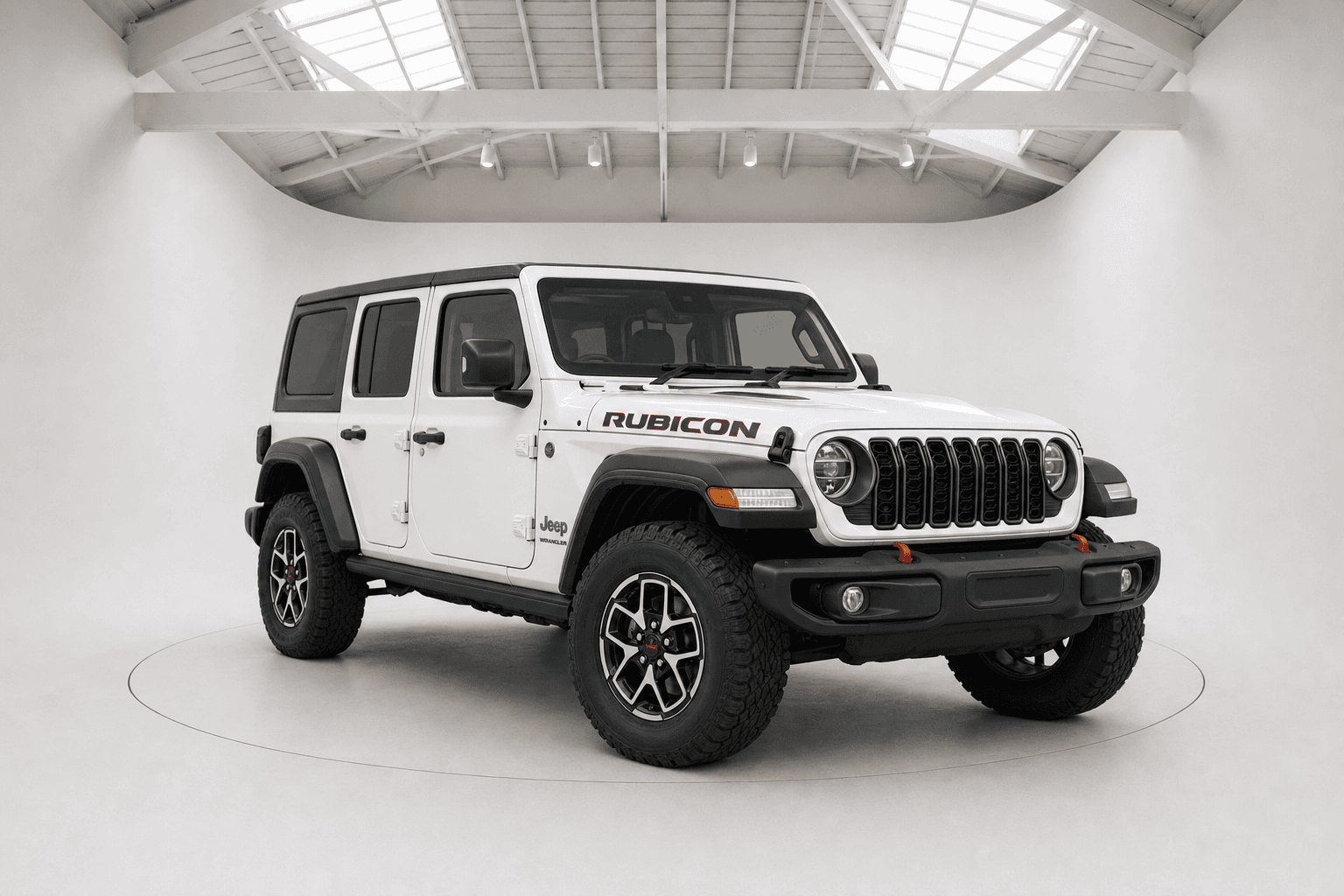
Some cars you buy with your head. The Jeep Wrangler is not one of them. Strip out the roof, pull the doors off, drop it into low range and point it at something a normal SUV would baulk at, and it makes complete sense. Park it in a school pick-up line and the justification gets harder. The current Rubicon-only range pairs genuine rock-crawling hardware with a 2.0-litre turbo-petrol four, a surprisingly plush cabin and on-road manners that ask for your patience. It is the most capable thing you can drive off a showroom floor, and it charges you for that everywhere else.
Twin lockers
Every Rubicon ships with front and rear locking diffs, a disconnecting sway bar and Dana solid axles.
Come off
Both roof panels lift out and every door unbolts for open-air driving.
Since 1941
The line runs straight back to the wartime Willys; the 85th Anniversary edition marks it.
200kW
Power400Nm
Torque1497–2495kg
Braked towing10.2L/100km
Fuel economyRange shown across the Wrangler line-up. Pick a priority to see the numbers that matter to you.
Images are illustrative and digitally rendered. They may not reflect the exact variant, colour or trim. Details →
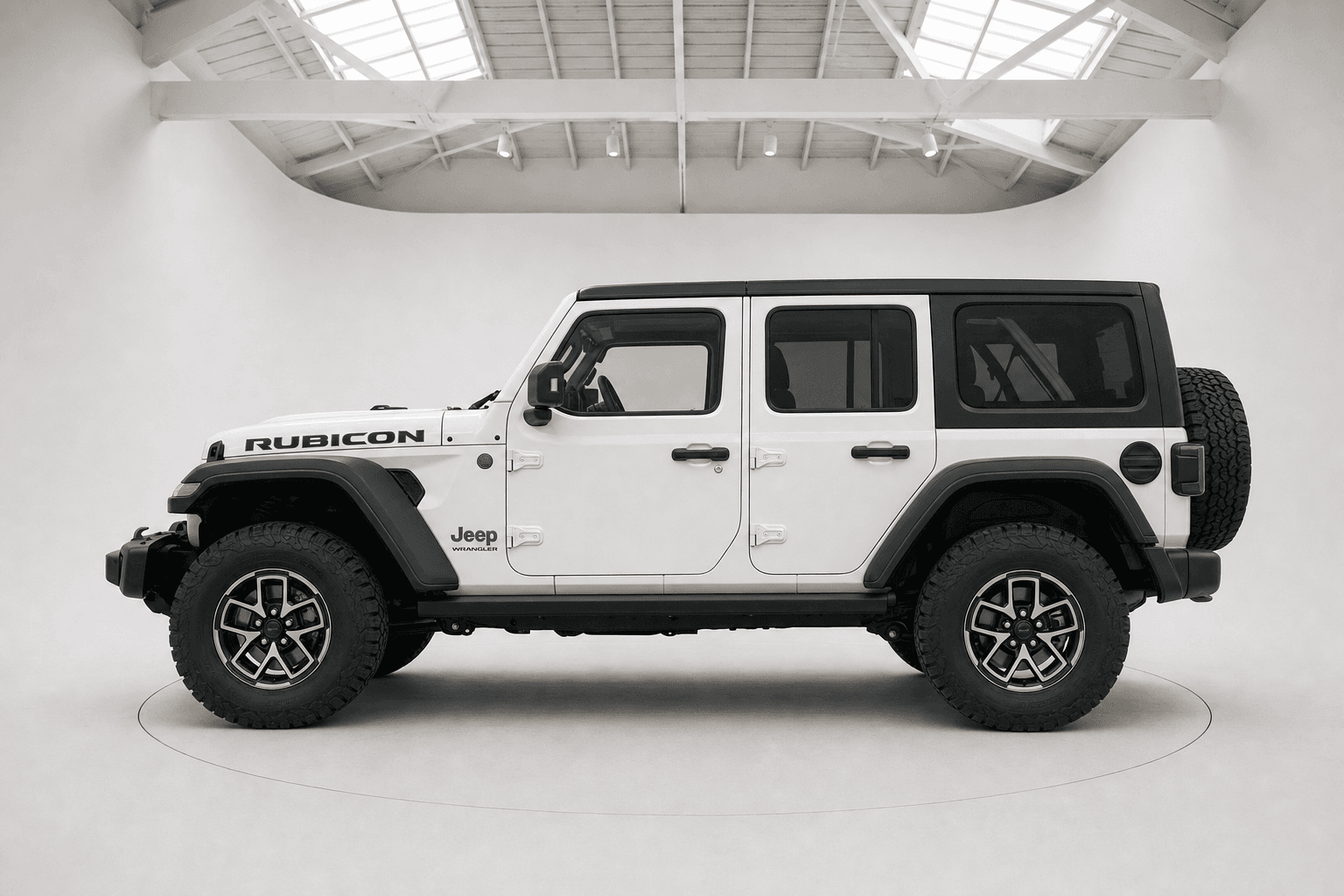
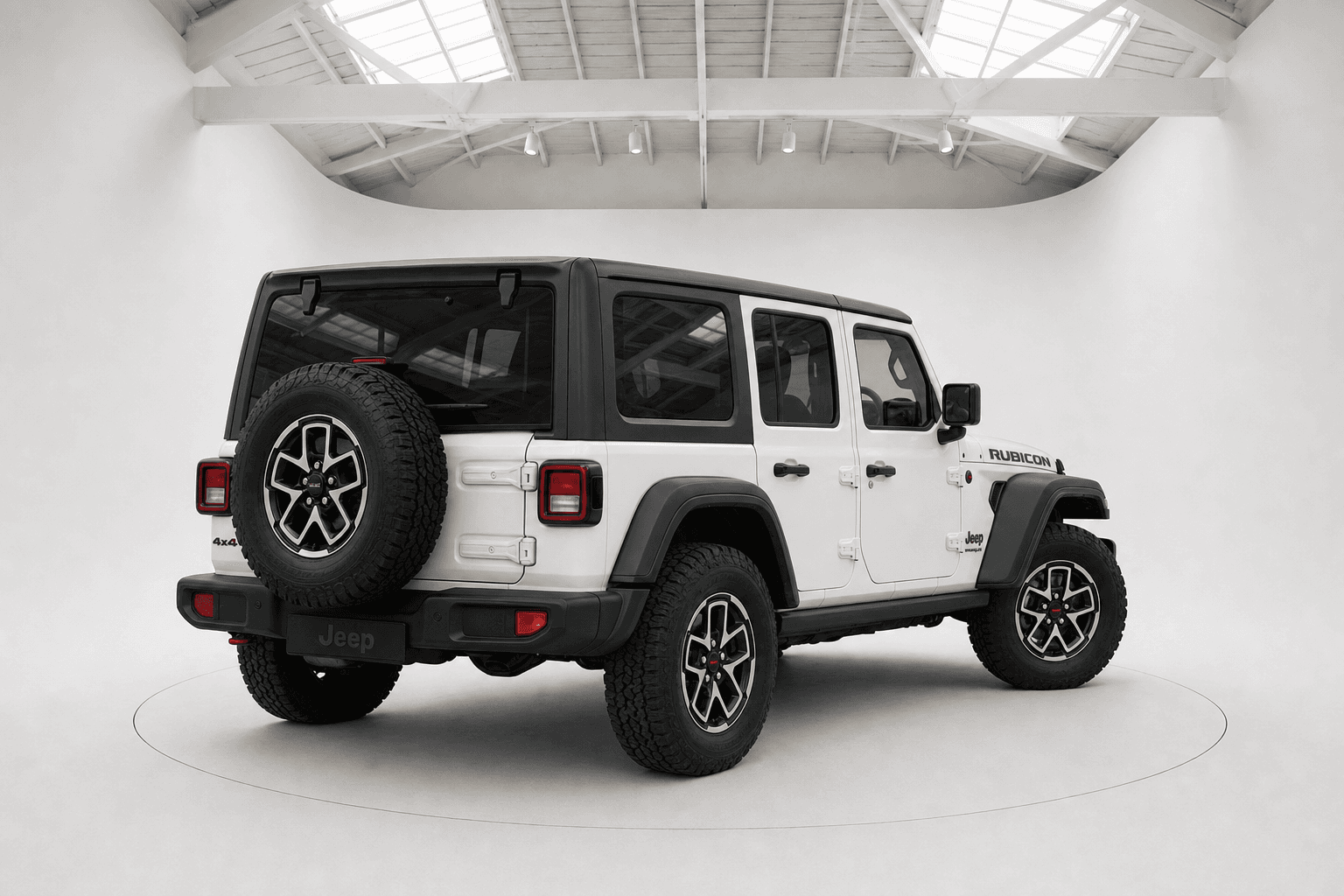
Jeep has narrowed the Wrangler down to its hardcore core. The MY26 range is Rubicon only, in short two-door or longer four-door Unlimited form, plus a limited 85th Anniversary edition built on the four-door. Every one runs Dana solid axles, front and rear locking differentials, an electronically disconnecting front sway bar and the Rock-Trac dual-range 4x4 system. The party trick nothing else in the class matches stays intact too: the roof panels lift out and the doors come off, now with quick-release hinges for 2026.
Under the bonnet sits a 2.0-litre turbo-petrol four making 200kW and 400Nm, paired with an eight-speed automatic. It replaced the old 3.6-litre Pentastar V6 a couple of updates back, and the reviewers who arrived sceptical left convinced. There is more usable mid-range torque and a more refined feel, with one honest caveat: it can seem a little flat in relaxed driving and only really wakes up when you lean on it. Official combined fuel use is 10.2L/100km on premium unleaded, so it is no economy story.
Take it onto a motorway and the trade-offs surface. The recirculating-ball steering is heavy and vague and does not self-centre, the short wheelbase fidgets over bumps, and the boxy shape and chunky tyres throw up real wind and tyre noise. The cabin is the surprise. Materials are genuinely premium, the controls feel solid and the 12.3-inch Uconnect screen is crisp, yet the packaging stays quirky: token rear seats, no dead pedal, and front seats that start to ache on a long haul.
None of this is a secret to the people who buy one. The Wrangler sells on capability and character, not sense, and it now shares a small club of serious off-roaders that has filled out around it. What none of the rivals copy is the party trick: a roof and doors you can leave in the shed. The pick is the four-door Unlimited, which keeps every bit of the capability and the open-air theatre while adding a back seat and a boot you can live with. Anyone chasing the smallest, purest tool takes the two-door instead; buyers who need a current safety rating or an easy daily should read the cross-shop in the verdict below.
85
The 85th Anniversary edition traces the Wrangler's line straight back to the 1941 Willys. Few new cars carry a bloodline that long.
The Wrangler range is short and singular: three takes on the Rubicon, all sharing the same 2.0-litre turbo, eight-speed auto and hardcore 4x4 hardware. You are choosing body length and trim, not capability.
From $87,638
The purest, shortest and cheapest Wrangler, and the keenest off-road of the three thanks to its tighter breakover angle. Four seats, less boot, a busier ride. The enthusiast's choice.
From $88,490
Mechanically the four-door Rubicon, dressed up: body-colour hard-top and flares, bronze tow hooks, plaid interior and badging. Around $3,500 over the Unlimited for the look, not extra ability.
From $90,972
The extra two doors and longer wheelbase buy a back seat people can actually use, more boot and a calmer ride, for a modest step up in price. The version most buyers should choose.
Driveaway estimate · NSW · priced Jul 2026. Varies by state. Details →
Fuel or charging, insurance, servicing, tyres and rego, with repayments if you finance it. Estimates for a NSW private buyer, not a quote.
The Jeep Wrangler is rated to tow up to 2,495 kg with a braked trailer and 750 kg without trailer brakes. That maximum applies to the 85th Anniversary; across the range the braked rating spans 1,497 kg to 2,495 kg.
Heaviest braked trailer allowed, quoted as ATM: the loaded trailer including ball weight.
2,495 kg
Limit for trailers without their own brakes.
750 kg
Gross vehicle mass: the most the loaded vehicle may weigh, ball weight included.
2,574 kg
Gross combination mass: vehicle and trailer together, both fully loaded.
4,819 kg
The vehicle as delivered, before people, cargo and accessories.
2,154 kg
Everything you may add, ball weight included. Calculated: 2,574 kg GVM minus 2,154 kg kerb weight.
420 kg
Calculated
Downward load on the tow ball; it counts toward GVM.
250 kg
Figures for the 85th Anniversary. Other grades differ; pick a variant in the checker below.
Hook up 2,495 kg with 250 kg on the ball and the 85th Anniversary has 170 kg of payload left for people, cargo and accessories.
The GCM allows the full payload and the full tow rating at the same time, which is rarer than it sounds in this class.
Assuming 10 per cent of the trailer weight.
Two adults plus luggage is roughly 400 kg.
Over a limit. This combination does not comply.
Tow rating
0 kg under the 2,495 kg braked rating
Vehicle GVM
Over GVM by 230 kg. Lighten the load or the ball.
Combined GCM
Over GCM by 230 kg. Trailer and load cannot both stay.
Tow ball limit
0 kg under the 250 kg ball limit
Figures are manufacturer maximums for the 85th Anniversaryand can change with model year; the compliance plate and handbook of your exact vehicle govern. In Australia, trailers over 750 kg GTM (the loaded weight on the trailer's own wheels) need their own brakes, and over 2,000 kg they need brakes on all wheels plus a breakaway system. Ball weight typically runs 8 to 12 per cent of ATM. Axle loads and tyre ratings are not modelled here. Checking a different car against your van? Use the towing calculator.
This model doesn't carry an ANCAP safety rating. Here's the active-safety equipment fitted across the range.
The Wrangler is the off-road icon that wins on capability and character rather than sense. Few new vehicles at any price match its standard Rubicon hardware (front and rear lockers, a disconnecting front sway bar, Rock-Trac low range and Dana solid axles), nothing in the class offers its removable roof and doors, and the cabin quality is a real surprise. It is also dear, thirsty on premium unleaded, compromised on-road, and saddled with the segment's weakest crash-safety reputation. The Land Rover Defender is the plusher, safer alternative and rides and steers better on road; the LandCruiser 70-series is the tougher workhorse and hauls heavier; the Ineos Grenadier shares the ladder-frame ethos for more money. None of them hands you a roof and doors you can pull off in the driveway. Buy the two-door Rubicon if hardcore trail capability is the whole brief; buy the four-door Unlimited if it has to work as a daily too.
Past generations. Context, not the car on sale today.
The Wrangler name dates to 1986, but its bloodline runs back to the 1941 Willys MB of the Second World War, through the CJ series and the YJ, TJ and JK Wranglers. The current JL generation reached Australia in 2019 as a vast on-road improvement over the JK it replaced, and it has been pared back and updated steadily since.
Arrived in Australia with a 3.6-litre Pentastar V6 and, on the Rubicon, a 2.2-litre turbo-diesel. Praised straight away as far more civilised on-road than the JK, while keeping the hardcore off-road hardware.
The 3.6-litre V6 made way for the current 2.0-litre turbo-petrol four, and the turbo-diesel was dropped. The related Gladiator ute kept the V6.
The line-up collapsed to Rubicon-only, with the Sport S and Overland grades axed, leaving the hardcore trim as the sole way into a Wrangler.
By Yuri Cartland, Editor