Large 4WD
Defender vs LandCruiser 300
Land Rover · Toyota
Head to head
Defender
110 S D250
Patrol
Ti-L
Last updated September 2026
From$115,242
From$117,483
The Land Rover Defender 110 S wins on capability and running costs: its 41.9-degree departure angle outreaches the Nissan Patrol Ti-L's 26.3, and its diesel claims 8.1L/100km to the Patrol V8's 14.4. The Nissan Patrol Ti-L is the better buy for space and kit: a 298kW V8, seven seats and a leather-lined flagship cabin for entry-Defender money.
486kg
The Nissan Patrol Ti-L outweighs the Defender D250 by 486kg yet both tow the same 3,500kg braked. The Defender banks the diet as 6.3 litres per 100km less thirst.
Pick a priority — we’ll show the numbers that matter and tell you which car we’d choose.
| Land Rover Defender | vsspecification | Nissan Patrol |
|---|---|---|
183 kW | Power | 298 kW (leads) |
570 Nm (leads) | Torque | 560 Nm |
3,500 kg | Braked towing | 3,500 kg |
8.1 L/100km (leads) | Fuel economy | 14.4 L/100km |
Based on Essentials, we’d pick the Land Rover Defender.
| Land Rover Defender | vsspecification | Nissan Patrol |
|---|---|---|
293 mm (leads) | Ground clearance | 273 mm |
37.6° (leads) | Approach | 28° |
42° (leads) | Departure | 26.3° |
The Defender is the sharper tool off-road. It brings a 37.6-degree approach, a huge 41.9-degree departure angle, 293mm of clearance and 900mm of wading, all well clear of the Patrol Ti-L's 28 and 26.3 degrees. Air suspension lets it raise the body for obstacles. The Patrol's size, low range and long range still make it a capable tourer, but on geometry the Land Rover leads.
Based on Off-road, we’d pick the Land Rover Defender.
| Land Rover Defender | vsspecification | Nissan Patrol |
|---|---|---|
3,500 kg | Braked towing | 3,500 kg |
3,200 kg | GVM | 3,500 kg (leads) |
A close call. Both tow 3500kg braked, the outback benchmark, so either will legally pull a big van. The Patrol Ti-L has a little more headroom around it, with a 7000kg combined-mass rating to the Defender's 6700 and a bigger 140-litre tank for range. The Defender counters with a much lighter body and its diesel torque. Near the limit the Patrol edges it; for most it is line-ball.
A genuine tie.
Both cars handle towing & weightsequally well — this one’s a draw.
| Land Rover Defender | vsspecification | Nissan Patrol |
|---|---|---|
183 kW | Power | 298 kW (leads) |
570 Nm (leads) | Torque | 560 Nm |
8.1 L/100km (leads) | Fuel economy | 14.4 L/100km |
The Patrol Ti-L takes power. Its 298kW, 560Nm 5.6-litre petrol V8 has well over a third more power than the Defender 110 S's 183kW, 570Nm 3.0-litre diesel, though torque is near level. The lighter Defender is quicker than its outputs suggest at a claimed 8.3 seconds to 100km/h, and its diesel is built for efficiency. But for outright muscle and V8 character, the Patrol wins.
Based on Engine & efficiency, we’d pick the Nissan Patrol.
| Land Rover Defender | vsspecification | Nissan Patrol |
|---|---|---|
8.1 L/100km (leads) | Fuel economy | 14.4 L/100km |
At matched money the Patrol Ti-L simply hands you more. About $117,000 buys the flagship Patrol, with leather, heated and ventilated seats, a sunroof, seven seats and the V8; the same outlay buys the cheapest Defender, base trim and five seats. The Defender's value is the badge, the safety rating and the economy rather than the kit list. For features per dollar, the Patrol leads clearly.
Based on Running costs, we’d pick the Nissan Patrol.
| Land Rover Defender | vsspecification | Nissan Patrol |
|---|---|---|
6 | Airbags | 6 |
Yes | AEB | Yes |
Yes | Adaptive cruise | Yes |
Yes | Blind-spot monitor | Yes |
Yes | 360° camera | Yes |
The Defender wins this outright. It holds a current five-star ANCAP rating tested in 2020, still valid on the on-sale 110, where the Patrol Ti-L carries no ANCAP rating at all. Both run the expected driver aids as standard, including autonomous emergency braking and lane-keep assist. But a five-star result against no rating is the single clearest safety gap between the two.
Based on Safety, we’d pick the Land Rover Defender.
| Land Rover Defender | vsspecification | Nissan Patrol |
|---|---|---|
5 | Seats | 7 (leads) |
13.1″ (leads) | Touchscreen | 12.3″ |
The Patrol Ti-L is the family choice on seats. It carries seven across three rows on captain's chairs, where the Defender 110 S is a five-seater with only an optional third row. The Ti-L's cabin is also the better-equipped of the two by a wide margin. The Defender answers with a bigger boot, but for seating a growing family the Patrol is the more natural fit.
Based on Everyday & family, we’d pick the Nissan Patrol.
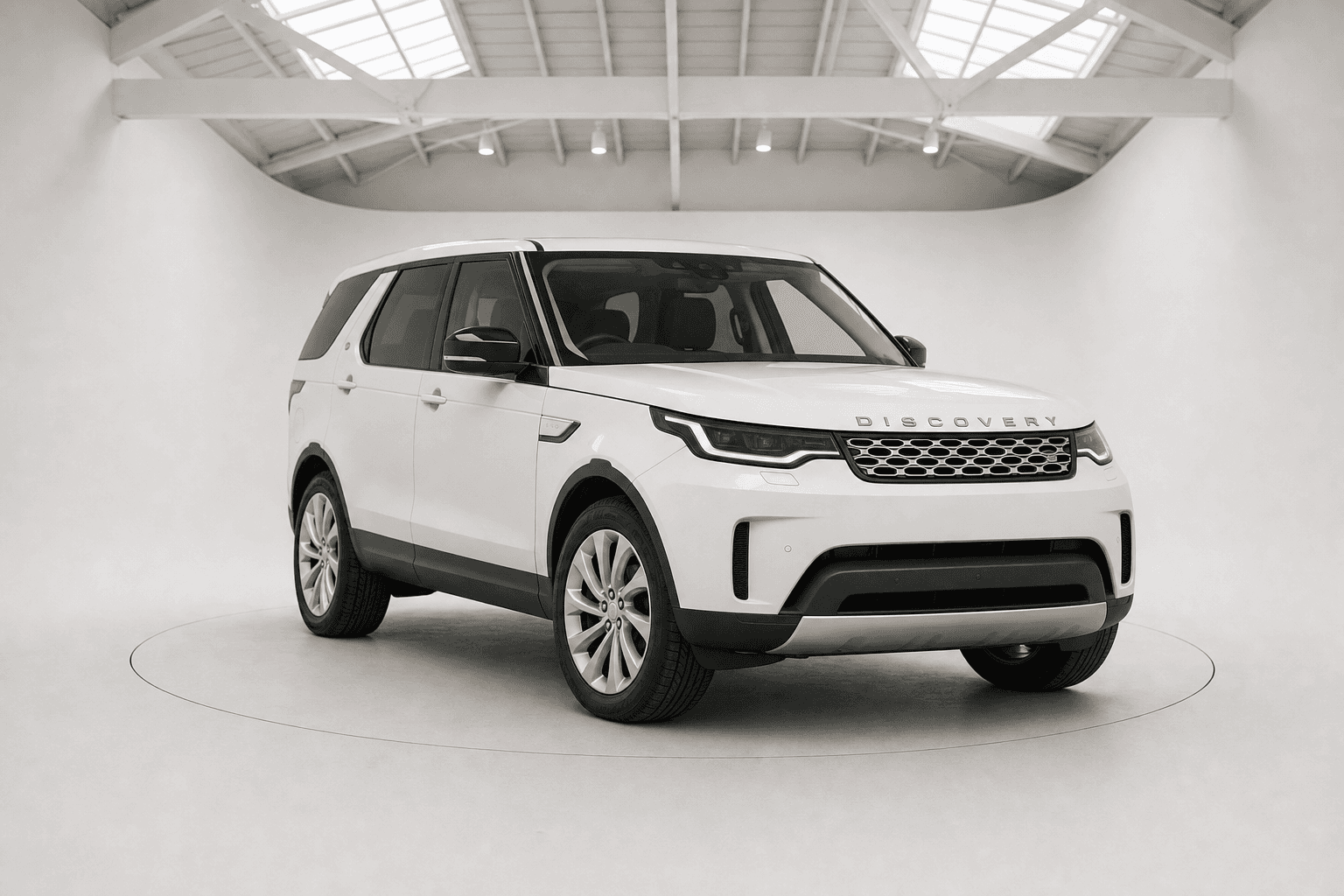
The Defender's face is modern-retro, a clean upright grille flanked by round LED headlights that nod to the original without copying it. In base 110 S trim it wears steel-look detailing and smaller wheels rather than the bright metal of dearer grades, but the silhouette still reads as the design-led SUV it is. It looks expensive in a way its plain cabin does not always back up.
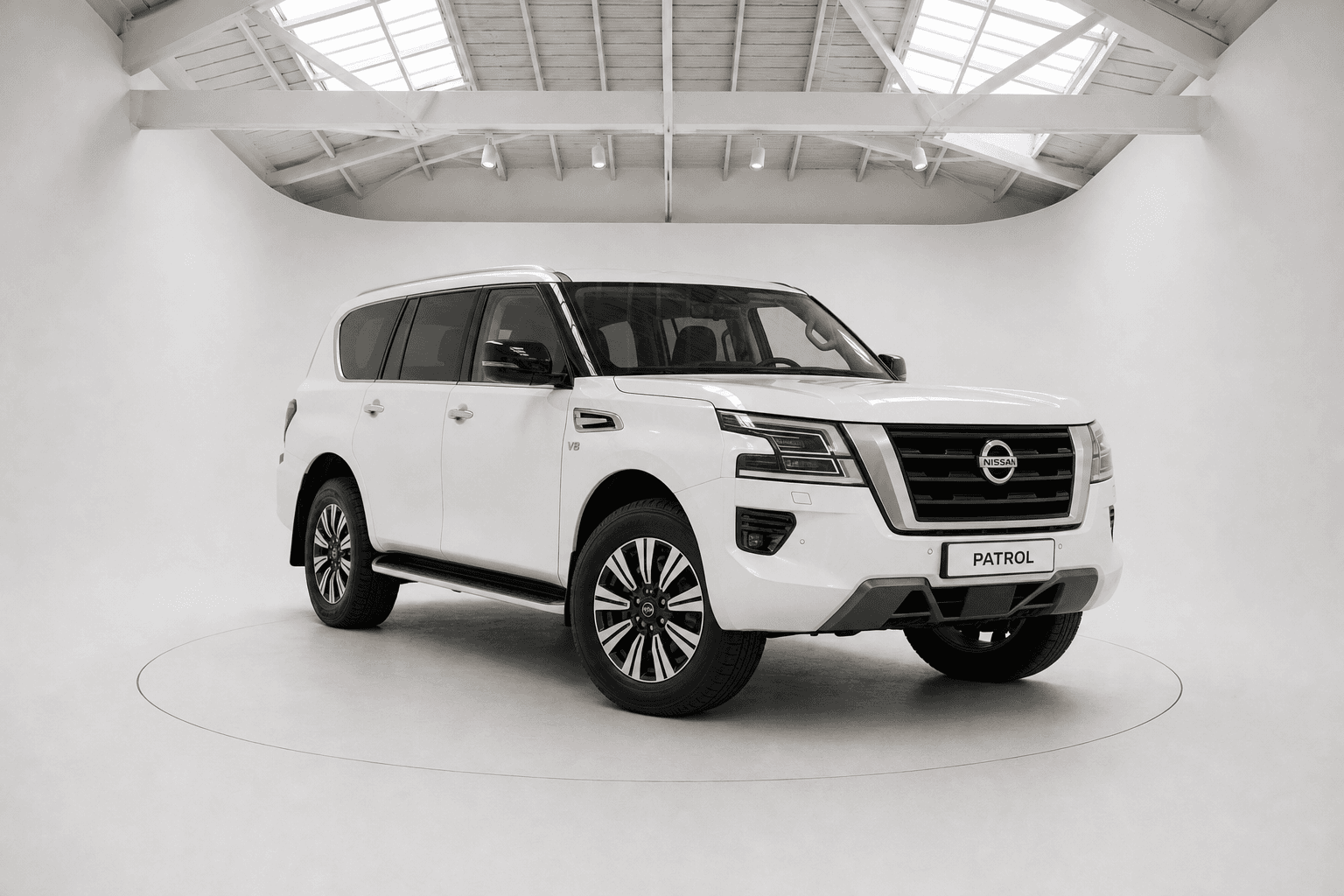
The Patrol Ti-L wears the full flagship face, a big upright chrome grille and a tall bonnet that make no secret of its size or its rank in the range. Where the Defender is styled and design-led, the Ti-L is imposing and traditional, all brightwork and presence. It is the more old-school look of the two, and in top trim it carries the chrome and lights to match its price.
Images are illustrative and digitally rendered. They may not reflect the exact variant, colour or trim. Details →
Defender
Patrol
Both are rated to tow 3,500 kg braked. Hitched at their maximums, the Land Rover Defender keeps 111 kg more payload.
3,500 kg
Braked towing3,500 kg
764 kg
Payload653 kg
414 kg
Payload at max tow303 kg
GVM
Limit that bites firstGVM
350 kg
Max ball weight350 kg
Assuming 10 per cent of the trailer weight.
Two adults plus luggage is roughly 400 kg.
Land Rover Defender 110 S D250
Fits within every published limit.
Tow rating
0 kg under the 3,500 kg braked rating
Vehicle GVM
14 kg spare after the ball weight and your load
Combined GCM
364 kg spare across the whole combination
Tow ball limit
0 kg under the 350 kg ball limit
Nissan Patrol Ti-L
Over a limit. This combination does not comply.
Tow rating
0 kg under the 3,500 kg braked rating
Vehicle GVM
Over GVM by 97 kg. Lighten the load or the ball.
Combined GCM
253 kg spare across the whole combination
Tow ball limit
0 kg under the 350 kg ball limit
Manufacturer maximums; the compliance plate of your exact vehicle governs. Ball weight assumed at 10 per cent where unpublished; kerb or payload calculated where the maker omits one. Check any car against your van with the towing calculator.
At this money the Defender is the entry point to its own range, and that is the honest catch.
The Ti-L flips that logic: it is the top of the Patrol range, so your $117,000 buys the flagship instead of the entry rung.
By Yuri Cartland, Editor
Opinions are our own.
The badge, genuine off-road hardware and running costs matter more to you than cabin luxury or a third row. You want the 37.6-degree approach, 900mm wading and 293mm of clearance, the current five-star ANCAP rating and the diesel's 8.1L/100km, and you accept paying flagship money to sit in the base grade with plain trim and five seats. Capability and image outweigh equipment for you.
Explore the DefenderYou want the most Patrol short of the Warrior: the 298kW petrol V8, seven seats on captain's chairs, and a fully loaded cabin with leather-accented, heated and ventilated seats, a sunroof and tri-zone climate. Kit, seats and grunt for your $117,000 matter more than a prestige badge, the safety rating or outright off-road geometry, and you are happy to feed a thirsty petrol V8 to get them.
Explore the Patrol