Premium 4WD
Defender vs LandCruiser 300
Land Rover · Toyota
Head to head
Defender
Discovery
Last updated September 2026
From$112,617
From$132,147
The Land Rover Discovery is the better Land Rover for a family: seven seats are standard where the Land Rover Defender charges for a third row, it carries eight airbags to six, and costs less on the same D350 diesel. The Defender is the choice for harder terrain: a 40-degree approach angle, one-metre wading and a newer cabin.
42.8°
The Defender OCTA leaves a ledge at 42.8 degrees; every Discovery exits at 30. Land Rover's own range splits here: the Defender line reaches harder terrain, the Discovery holds seven seats.
Pick a priority — we’ll show the numbers that matter and tell you which car we’d choose.
| Land Rover Defender | vsspecification | Land Rover Discovery |
|---|---|---|
183 kW | Power | 257 kW (leads) |
570 Nm | Torque | 700 Nm (leads) |
3,500 kg | Braked towing | 3,500 kg |
8.1 L/100km | Fuel economy | 7.8 L/100km (leads) |
Based on Essentials, we’d pick the Land Rover Discovery.
| Land Rover Defender | vsspecification | Land Rover Discovery |
|---|---|---|
295 mm (leads) | Ground clearance | 286 mm |
37.5° (leads) | Approach | 33.6° |
41.9° (leads) | Departure | 30° |
900 mm | Wading depth | 900 mm |
The Defender is the more capable in the rough, with a 40-degree approach angle to the Discovery's 33.6, a one-metre wading depth to 900mm, 323mm of air-sprung clearance to 285, and the 2026 best-off-road-SUV title. The Discovery is capable too, sharing air suspension and real off-road ability, and will follow the Defender down most family-grade tracks. On the hard stuff, though, the Defender clears out.
Based on Off-road, we’d pick the Land Rover Defender.
| Land Rover Defender | vsspecification | Land Rover Discovery |
|---|---|---|
3,500 kg | Braked towing | 3,500 kg |
2,970 kg | GVM | 3,245 kg (leads) |
Level. Both tow 3500kg braked on the same 257kW, 700Nm D350 diesel and share air-suspension platforms, so there is nothing to separate them on the numbers. Each makes a capable, composed tow vehicle, and the choice comes down to the rest of the decision, the Defender for capability and presence, the Discovery for a comfortable seven-seat cabin behind the same drivetrain.
A genuine tie.
Both cars handle towing & weightsequally well — this one’s a draw.
| Land Rover Defender | vsspecification | Land Rover Discovery |
|---|---|---|
183 kW | Power | 257 kW (leads) |
570 Nm | Torque | 700 Nm (leads) |
8.1 L/100km | Fuel economy | 7.8 L/100km (leads) |
8.0 s | 0–100 | 6.3 s (leads) |
A dead heat where it counts. Both use the same 3.0-litre D350 mild-hybrid diesel making 257kW and 700Nm, so a diesel Defender and a diesel Discovery accelerate and pull identically, each rated to 3500kg braked. The only separation is above the diesel, where the Defender range adds a supercharged V8 and a 467kW OCTA the single-engine Discovery cannot match. Diesel for diesel, they are the same.
A genuine tie.
Both cars handle engine & efficiencyequally well — this one’s a draw.
| Land Rover Defender | vsspecification | Land Rover Discovery |
|---|---|---|
8.1 L/100km | Fuel economy | 7.8 L/100km (leads) |
The Discovery makes the stronger upfront case. It undercuts an equivalent D350 Defender, includes the standard third row and the extra airbags, and the older platform means sharper deals. The Defender answers with stronger resale and desirability that narrow the gap over time. For a family buying a seven-seat diesel and keeping it a few years, the Discovery is the better value; for resale, the Defender.
Based on Running costs, we’d pick the Land Rover Discovery.
| Land Rover Defender | vsspecification | Land Rover Discovery |
|---|---|---|
6 | Airbags | 8 (leads) |
Yes | AEB | Yes |
Yes | Adaptive cruise | Yes |
Yes | Blind-spot monitor | Yes |
Yes | 360° camera | Yes |
Neither takes it cleanly. The Defender holds a five-star ANCAP rating, though from 2020 and expiring at the end of 2026, and it excludes its V8 variants. The current Discovery is unrated, its 2017 rating having lapsed at the end of 2023, so the Defender has the only live result of the two. The Discovery answers with eight airbags to the Defender's six, and both run the expected driver aids.
Based on Safety, we’d pick the Land Rover Defender.
| Land Rover Defender | vsspecification | Land Rover Discovery |
|---|---|---|
5 | Seats | 7 (leads) |
397 L | Boot | 1,137 L (leads) |
13.1″ (leads) | Touchscreen | 11.4″ |
The Discovery's category. Seven seats are standard where the Defender options a third row, the ride is softer and better suited to daily use, the conventional tailgate is easier than the Defender's side-swing door, and it carries eight airbags to the Defender's six. The Defender 130 counters with up to eight seats, but for comfort, everyday practicality and value in a three-row SUV, the Discovery is the more sensible family buy.
Based on Everyday & family, we’d pick the Land Rover Discovery.
The Defender's face is the segment's most distinctive, a clean, upright panel of round LED lights and a simple grille that reads as modern-industrial rather than aggressive. Deployable side steps and available 22-inch wheels signal how far up-market the range climbs. Parked next to its sibling, it is the one that draws the eye, and much of the Defender's appeal is in exactly that presence.
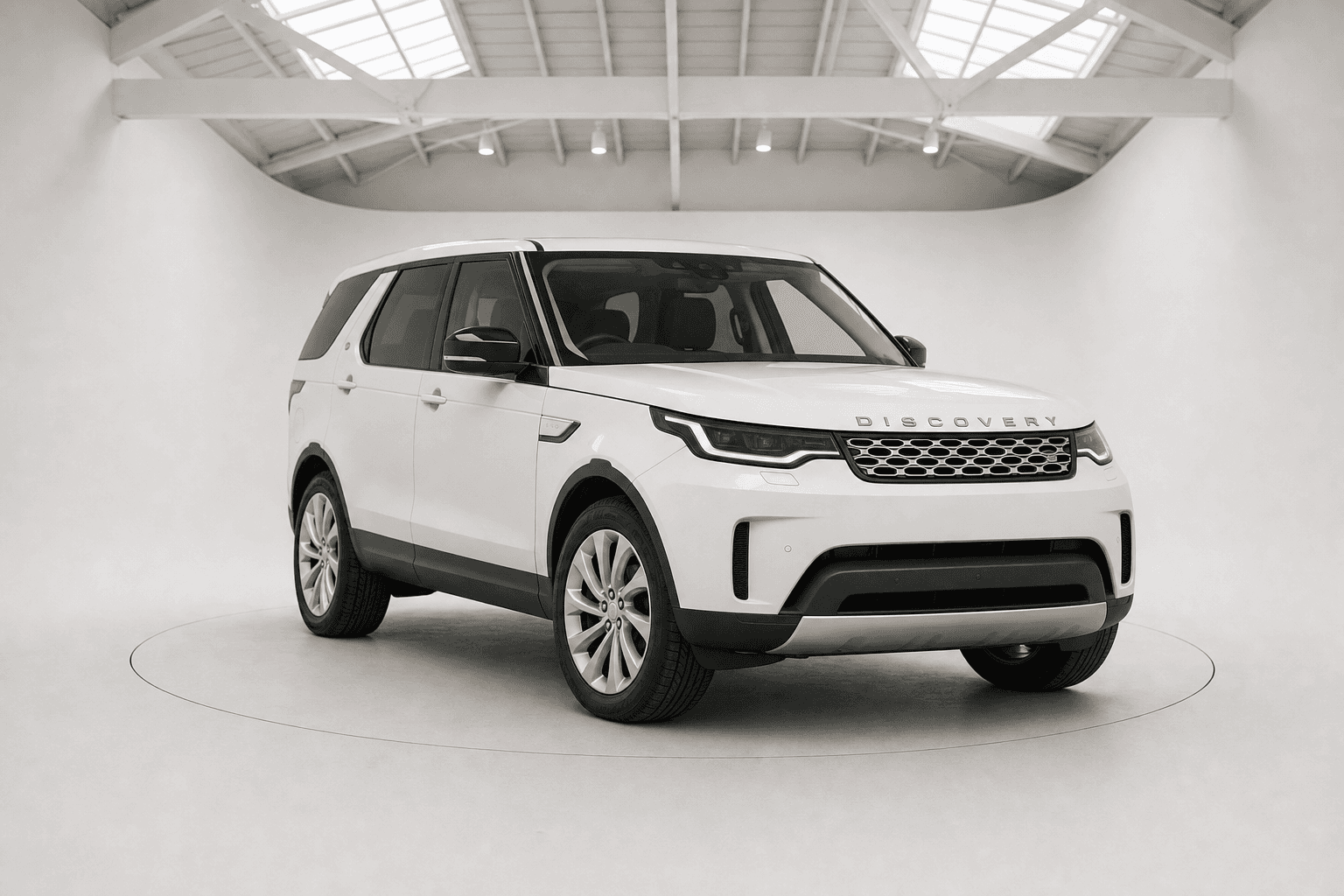
The Discovery's nose is softer and more conventional, a family-SUV face rather than an off-road statement, and it has aged since this generation arrived. It looks more anonymous than the Defender, less a fashion object than a practical tool, which suits its brief. Where the Defender wants to be noticed, the Discovery is content to blend into the school pickup line without comment.
Images are illustrative and digitally rendered. They may not reflect the exact variant, colour or trim. Details →
Defender
Discovery
Both are rated to tow 3,500 kg braked. Hitched at their maximums, the Land Rover Defender keeps 42 kg more payload.
3,500 kg
Braked towing3,500 kg
645 kg
Payload803 kg
495 kg
Payload at max tow453 kg
GVM
Limit that bites firstGVM
150 kg
Max ball weight350 kg
Assuming 10 per cent of the trailer weight.
Two adults plus luggage is roughly 400 kg.
Land Rover Defender OCTA Black
Over a limit. This combination does not comply.
Tow rating
0 kg under the 3,500 kg braked rating
Vehicle GVM
Over GVM by 105 kg. Lighten the load or the ball.
Combined GCM
245 kg spare across the whole combination
Tow ball limit
Over the 150 kg ball limit by 200 kg
Land Rover Discovery Dynamic SE
Fits within every published limit.
Tow rating
0 kg under the 3,500 kg braked rating
Vehicle GVM
53 kg spare after the ball weight and your load
Combined GCM
403 kg spare across the whole combination
Tow ball limit
0 kg under the 350 kg ball limit
Manufacturer maximums; the compliance plate of your exact vehicle governs. Ball weight assumed at 10 per cent where unpublished; kerb or payload calculated where the maker omits one. Check any car against your van with the towing calculator.
Same badge, same D350 diesel, different job.
The Discovery answers a different question, and for a lot of families it is the better one.
By Yuri Cartland, Editor
Opinions are our own.
Off-road capability, cabin technology and the way the truck looks matter more than a standard third row, and you want the newer platform, the bigger screen and the current safety rating. You are drawn to the presence and the resale the Discovery cannot match, you can live with the side-hinged door, and you accept paying more, once optioned, for the most desirable Land Rover 4WD in the range.
Explore the DefenderA comfortable, roomy seven-seat family SUV is the actual brief, and on-road ride and easy day-to-day use matter more than extreme off-road ability or badge appeal. You want the standard third row, the eight airbags and the lower price of an equivalent Defender, you will keep it out of the serious rough, and you would rather have the practical Land Rover than the fashionable one.
Explore the Discovery