Large 4WD
Everest vs MU-X
Ford · Isuzu
Head to head
B5
Everest
Last updated September 2026
From$82,138
From$60,000
Families needing a third row or a 3,500kg tow rating belong in the Ford Everest: it seats up to seven where the Denza B5 stops at five, tows 500kg more, and carries a proven diesel record. The Denza B5 is the choice for power and plug-in running: 400kW and a claimed 90km of WLTC electric-only range.
400kW
Every Denza B5 lands with 400kW, more than double the strongest Everest's 184kW. Ford's reply is workhorse breadth: the Everest tows 3,500kg braked where the B5 stops at 3,000.
Pick a priority — we’ll show the numbers that matter and tell you which car we’d choose.
| Denza B5 | vsspecification | Ford Everest |
|---|---|---|
400 kW (leads) | Power | 125 kW |
760 Nm (leads) | Torque | 405 Nm |
3,000 kg | Braked towing | 3,500 kg (leads) |
3.9 L/100km (leads) | Fuel economy | 7.1 L/100km |
Based on Essentials, we’d pick the Denza B5.
| Denza B5 | vsspecification | Ford Everest |
|---|---|---|
220 mm | Ground clearance | 229 mm (leads) |
35° (leads) | Approach | 30.4° |
32° (leads) | Departure | 25.3° |
700 mm | Wading depth | 800 mm (leads) |
Line-ball, on different strengths. The B5 brings steeper approach and departure angles and instant electric torque for low-speed control, though its wading and clearance trail the Ford. The Everest counters with a proven mechanical four-wheel-drive, a rear diff lock on its off-road grades and deeper wading. So the B5 is the more high-tech off-roader, the Everest the more proven one. Both are seriously capable in the rough.
A genuine tie.
Both cars handle off-roadequally well — this one’s a draw.
| Denza B5 | vsspecification | Ford Everest |
|---|---|---|
3,000 kg | Braked towing | 3,500 kg (leads) |
600 kg | Payload | 855 kg (leads) |
3,497 kg (leads) | GVM | 3,100 kg |
The Everest takes towing. Both pull respectable loads, but the Everest is rated to 3,500kg braked to the B5's 3,000, and its proven diesel and long range suit hauling a big van over distance without charging. The B5's electric torque is strong off the line, but its efficiency fades under heavy load. For serious towing, the diesel Ford is the safer tool of the two.
Based on Towing & weights, we’d pick the Ford Everest.
| Denza B5 | vsspecification | Ford Everest |
|---|---|---|
400 kW (leads) | Power | 125 kW |
760 Nm (leads) | Torque | 405 Nm |
3.9 L/100km (leads) | Fuel economy | 7.1 L/100km |
The B5 takes performance in a landslide. Its plug-in-hybrid drivetrain makes a combined 400kW and 760Nm to the Everest's 125 to 184kW diesel, more than double the Ford's best, and it claims 4.8 seconds to 100km/h, genuinely quick for a 4WD. The Everest's diesel answers with proven, towing-friendly torque, but for outright pace and power the electrified Denza is in another class entirely.
Based on Engine & efficiency, we’d pick the Denza B5.
| Denza B5 | vsspecification | Ford Everest |
|---|---|---|
3.9 L/100km (leads) | Fuel economy | 7.1 L/100km |
A split by budget and priority. The Everest opens far cheaper, from $60,000 driveaway, and its proven ownership and seven-seat practicality make it the value pick for many families. The B5 starts higher, near $82,000, but hands you 400kW, plug-in efficiency and the newest tech for the money. So the Everest wins on entry price and proven value; the B5 on power and technology per dollar. Which is better value depends on what you want.
A genuine tie.
Both cars handle running costsequally well — this one’s a draw.
| Denza B5 | vsspecification | Ford Everest |
|---|---|---|
5★ | ANCAP | 5★ |
86% | Adult occupant | 86% |
78% | Safety assist | 86% (leads) |
11 (leads) | Airbags | 9 |
Yes | AEB | Yes |
Yes | Adaptive cruise | Yes |
Yes | Blind-spot monitor | Yes |
A close five-star result. Both are rated five stars, with the B5 carrying more airbags, including a centre airbag, and scoring higher for child protection, and the Everest edging the safety-assist score with its proven driver aids. Both run autonomous emergency braking as standard. Passive protection leans to the B5, assist systems to the Everest, but on the rating itself the two are evenly matched.
A genuine tie.
Both cars handle safetyequally well — this one’s a draw.
| Denza B5 | vsspecification | Ford Everest |
|---|---|---|
5 | Seats | 5 |
470 L | Boot | 898 L (leads) |
15.6″ (leads) | Touchscreen | 12.0″ |
The Everest is the more practical family choice. It offers up to seven seats where the B5 seats only five, and it carries a bigger boot both behind the seats and folded. The B5 answers with more power, plug-in efficiency and more airbags in a well-equipped five-seat cabin. But for families who need the third row and the extra space, the Everest is the clear fit.
Based on Everyday & family, we’d pick the Ford Everest.
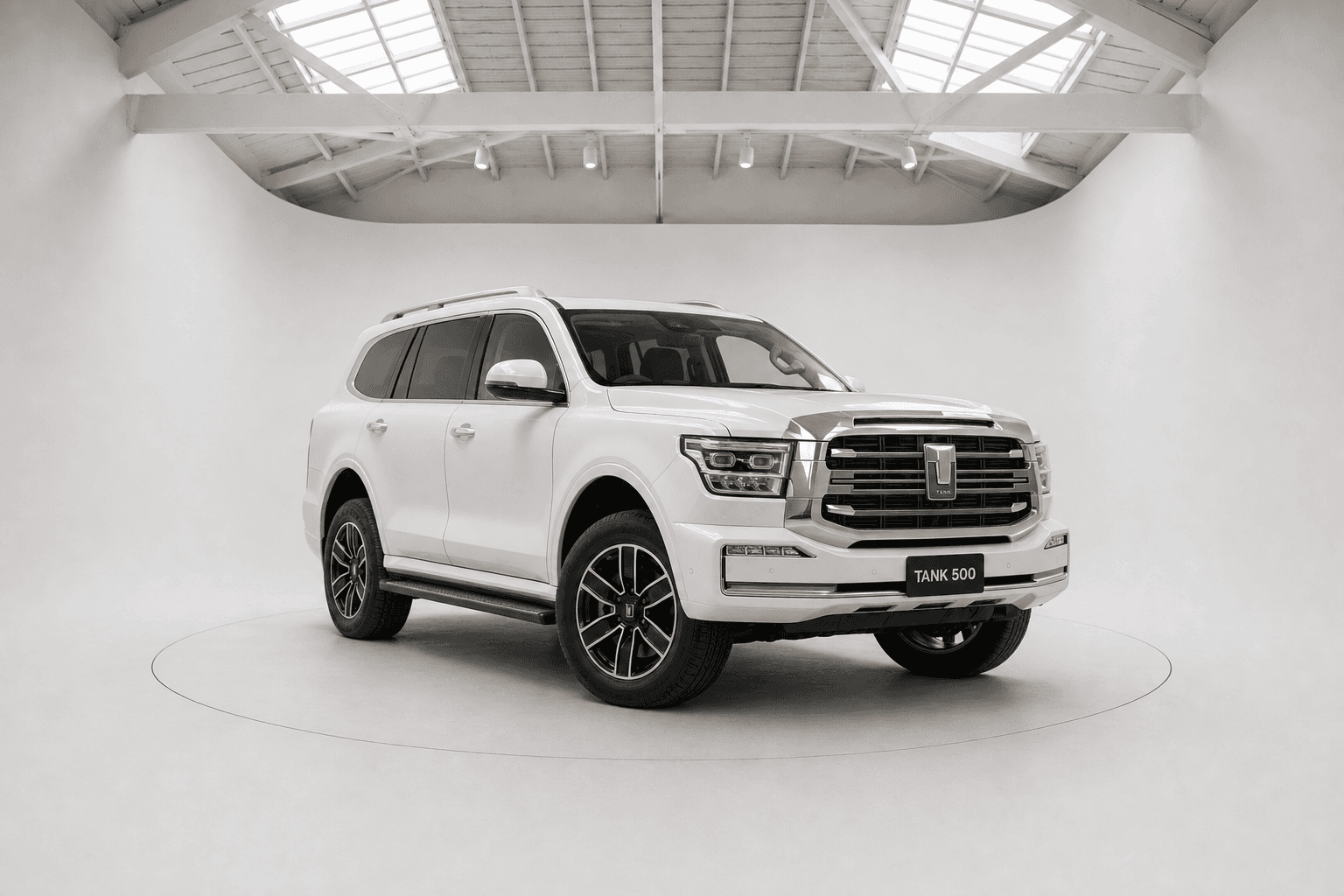
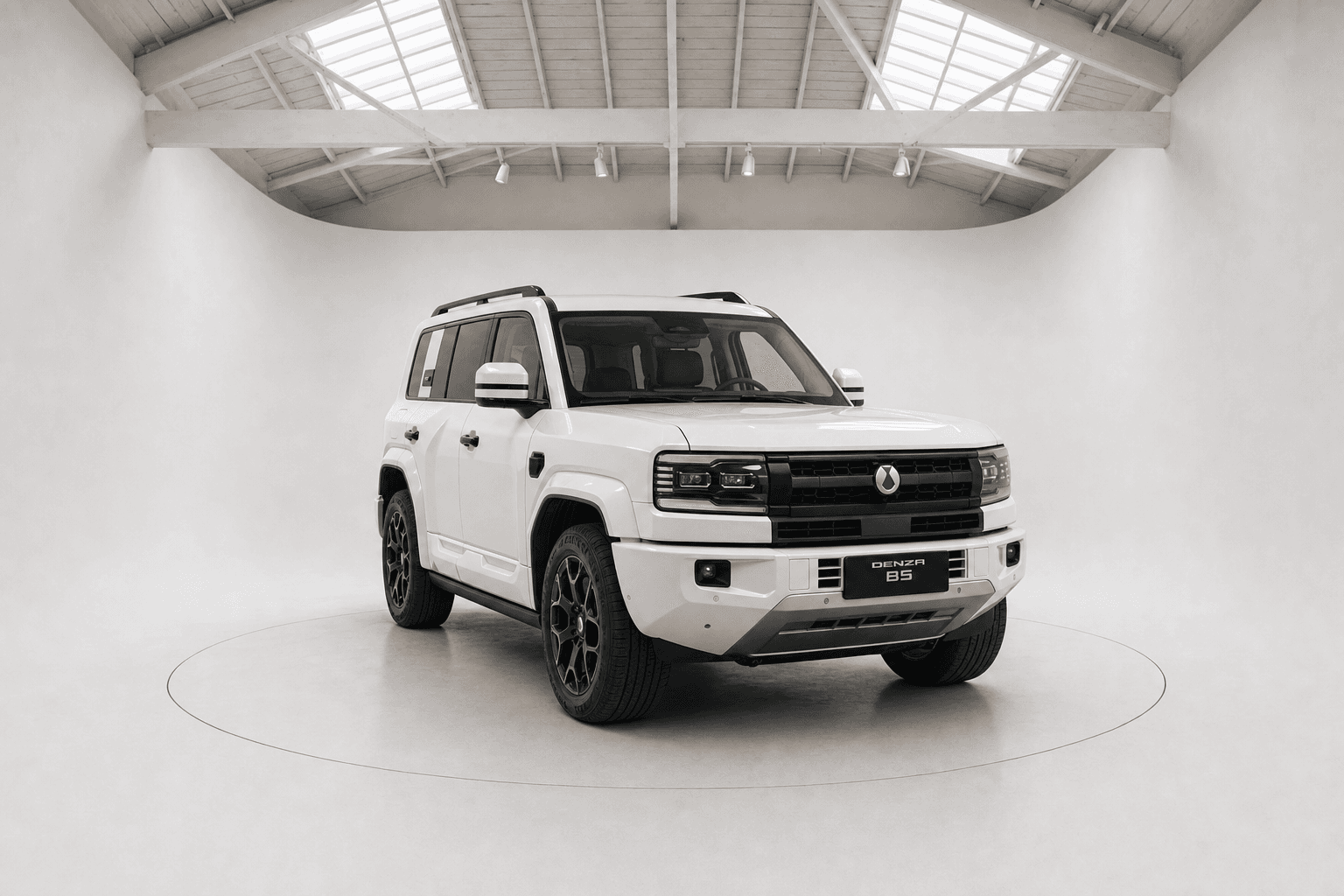
The B5 wears a bold, blocky, modern face, with a wide grille, sharp LED signatures and the chunky, upright proportions of a serious off-roader. It looks distinctly new and high-tech next to the familiar Ford, a deliberate statement that this is something different in the class. Where the Everest is proven and conventional, the B5 is styled to signal its electrified, premium ambitions from the first glance.
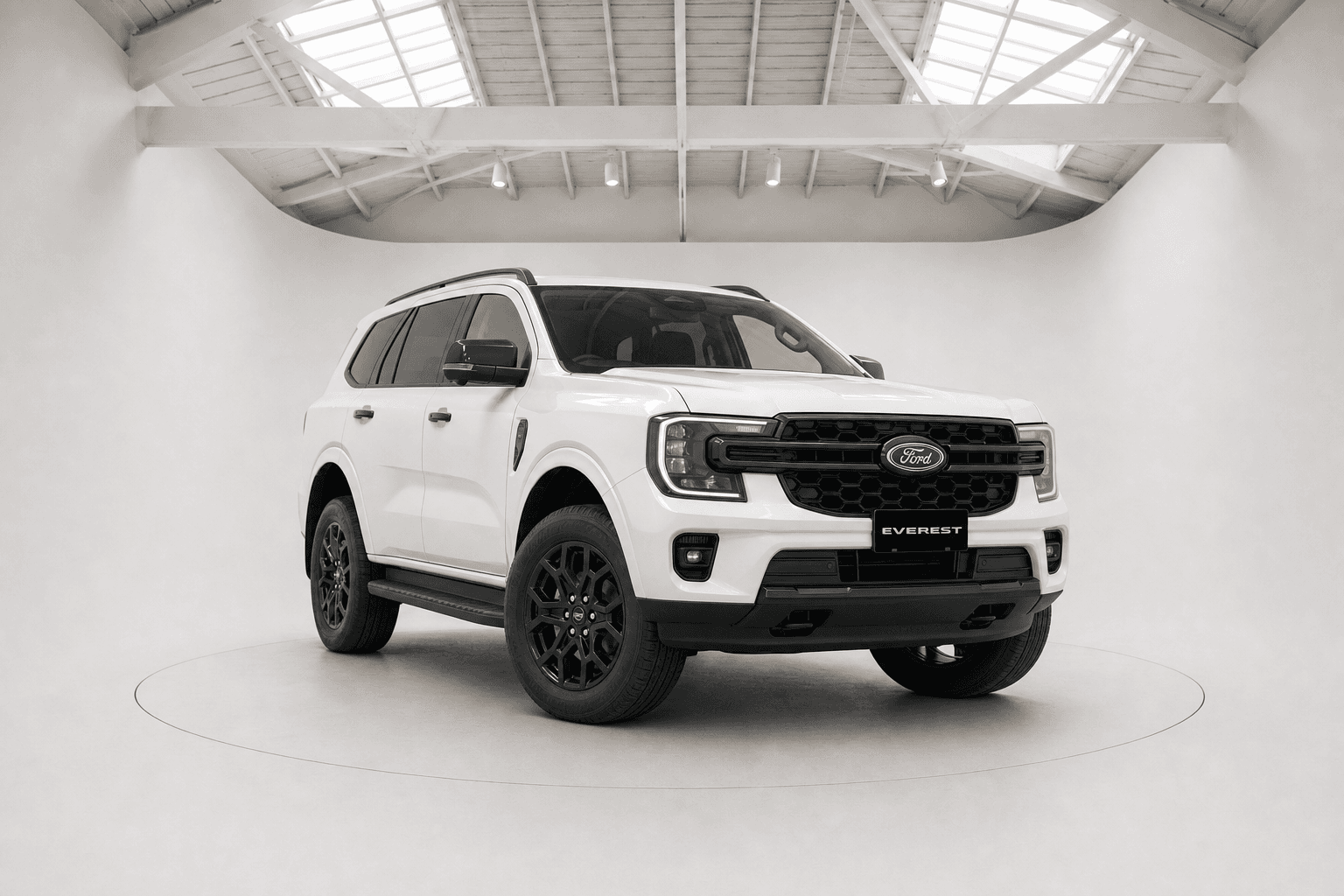
The Everest wears the tough, familiar face of Australia's benchmark 4WD, sharing much of its front with the Ranger ute it is based on. It looks purposeful and proven rather than flashy, with a broad grille and squared-off lines built for the bush. Next to the futuristic B5 it is the more conventional and understated of the two, the look of a vehicle that has earned its reputation over years.
Images are illustrative and digitally rendered. They may not reflect the exact variant, colour or trim. Details →
B5
Everest
The Ford Everest tows 500 kg more than the Denza B5. Hitched at their maximums, the Ford Everest keeps 280 kg more payload.
3,000 kg
Braked towing3,500 kg
600 kg
Payload855 kg
225 kg
Payload at max tow505 kg
GCM
Limit that bites firstGVM
Not published
Max ball weight350 kg
Assuming 10 per cent of the trailer weight.
Two adults plus luggage is roughly 400 kg.
Denza B5 B5
Over a limit. This combination does not comply.
Tow rating
0 kg under the 3,000 kg braked rating
Vehicle GVM
Over GVM by 100 kg. Lighten the load or the ball.
Combined GCM
Over GCM by 175 kg. Trailer and load cannot both stay.
Tow ball limit
No published limit. Vans usually need 8 to 12 per cent of ATM on the ball.
Ford Everest Active 2.0L Turbo Diesel AWD
Fits within every published limit.
Tow rating
500 kg under the 3,500 kg braked rating
Vehicle GVM
155 kg spare after the ball weight and your load
Combined GCM
605 kg spare across the whole combination
Tow ball limit
50 kg under the 350 kg ball limit
Manufacturer maximums; the compliance plate of your exact vehicle governs. Ball weight assumed at 10 per cent where unpublished; kerb or payload calculated where the maker omits one. Check any car against your van with the towing calculator.
The B5 is Denza's electrified answer to the diesel establishment, and its headline is power.
The Everest is the proven diesel benchmark this class is measured against, and its case is breadth and pedigree.
By Yuri Cartland, Editor
Opinions are our own.
Outright power, plug-in efficiency and cabin technology matter more to you than a third row or a proven badge. You want the 400kW plug-in-hybrid drivetrain, the 4.8-second sprint, the roughly 90km of electric range, the big 15.6-inch screen and the steeper off-road angles, and you accept five seats, a 3,000kg tow limit and an unproven brand to have the most powerful, most efficient off-roader here.
Explore the B5Seven seats, heavy-duty towing, a proven badge and a lower entry price matter more to you than outright power or plug-in running. You want up to seven seats, the 3,500kg towing, the proven diesel drivetrain and Ford's reliability and resale record, and you can accept far less power and no electric efficiency to have the established, more practical family 4WD at a lower entry price.
Explore the Everest